After being informed on August 12 that my transit through the Russian Arctic, and hence my solo Arctic circumnavigation, was no longer possible because the NSRA determined that ice and weather conditions were too difficult and dangerous for small boats, I started looking for a weather window to return to the US East Coast.
I waited until August 16 for that window. After motoring from Hammerfest to the open ocean, I was met with strong winds out of the north, much stronger than forecast, with attendant high seas. It was a fast but rough 3 – 4 days of sailing. Arriving east of Iceland, things only got worse with now upwind sailing conditions, with variable wind directions, as I tried to work my way south and west around the southern side of Iceland. The winds finally rotated to the south but for 12 hours I was on a very rough beam reach with 30+ kt winds and 3 to 4 meter seas. Very rolly, heeled over conditions. Three reefs in the sails. Some of the roughest sailng I can recall.
I’m past Iceland now in lighter winds and seas, on a route largely southwest toward Newfoundland, my target landfall. I don’t know if I’ll stop there, but perhaps move on to Lunenburg, Nova Scotia, for a rest stop instead. I’ve never been to Nova Scotia.
There’s a big low pressure system looming in the forecast between Newfoundland and my current position, several days off. Hopefully it will dissipate or I can work my way around it without too much drama.
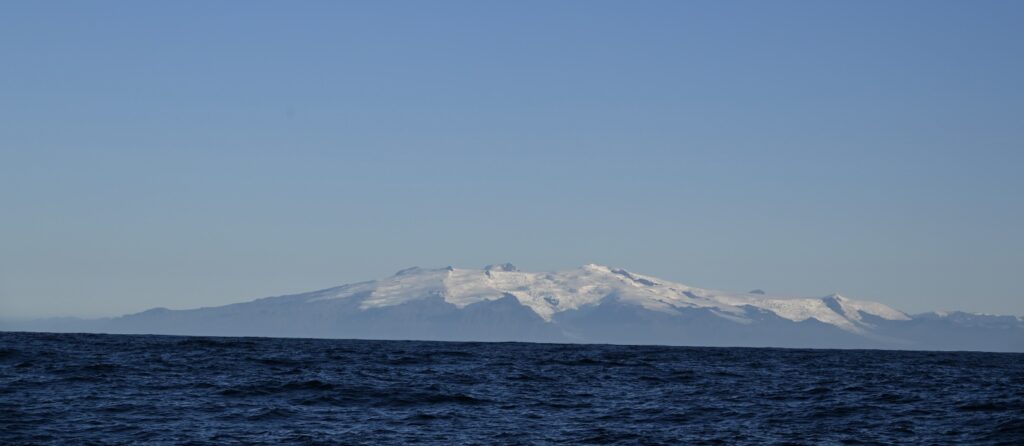
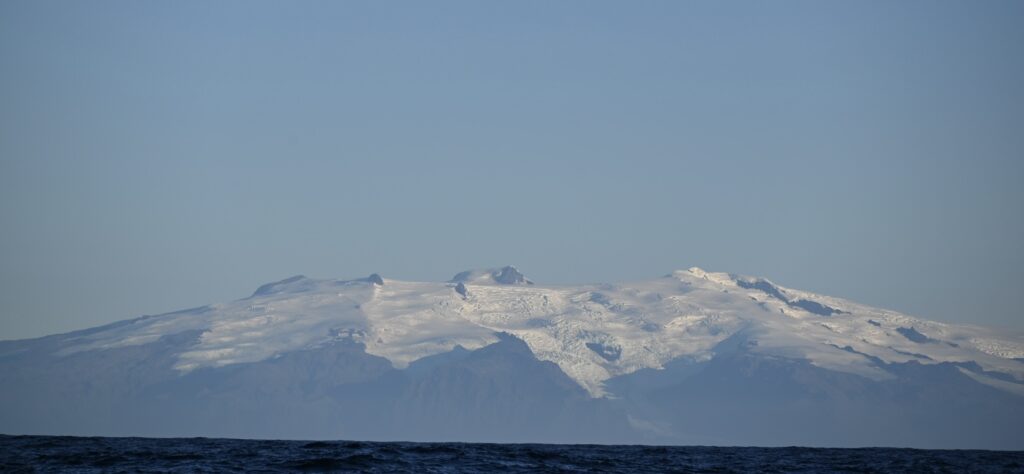
The photos are of Iceland as I sailed by along the south side, taken on one of the very few blue sky days I’ve had on this entire voyage into the Arctic.
Because of the very difficult and dangerous ice conditions in the Russian Arctic along the Northern Sea Route (NSR) this year, the NSR authorites advised us yesterday to postpone our planned transits until next year when more favorable ice conditions may be present. Currently, things are so difficult that ice-rated commercial ships are getting stuck and requesting icebreaker assistance. The weather forecast calls for sub-zero temperatures across the Chukchi and New Siberian Seas next week. Obviously, ice conditions will worsen with such weather.
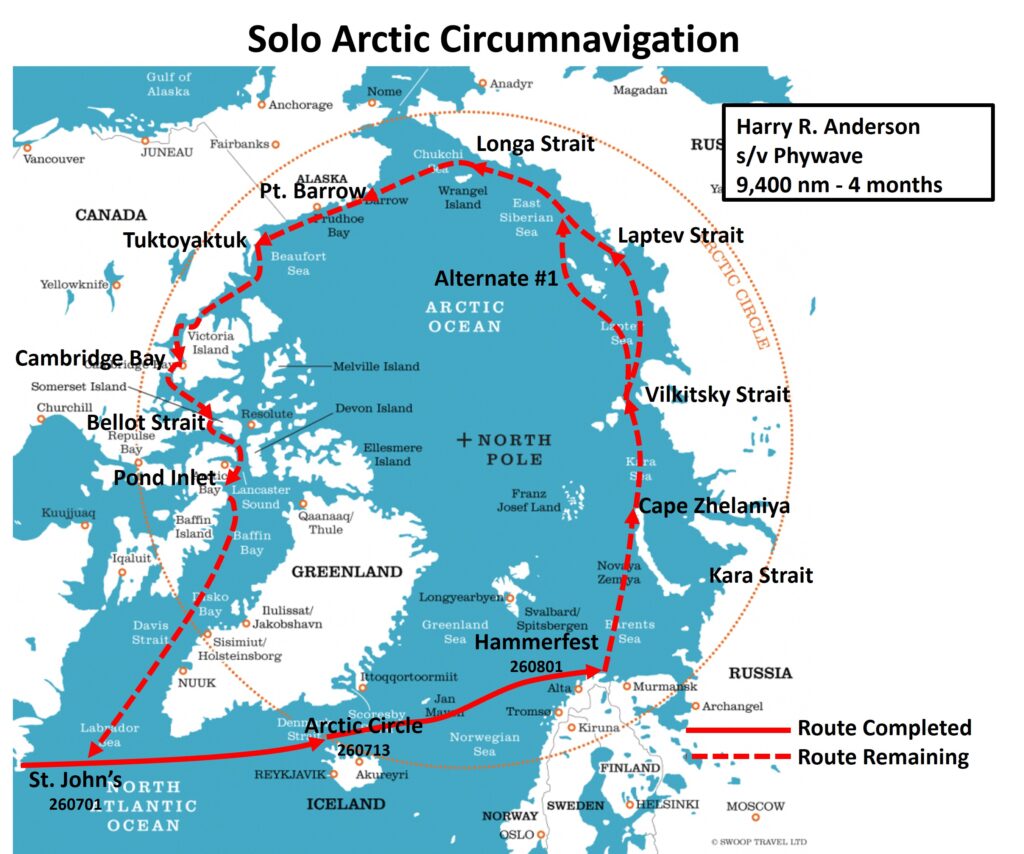
In a previous post I noted how I was waiting in Hammerfest, Norway, for ice conditions to improve in the Vilkitsky Strait. Well, now I will be looking for a weather window to head back to the US East Coast; my plans are uncertain after that. It’s unlikely I’ll try this solo Arctic circumnavigation next year.
There were four solo sailors attempting to transit the NSR this year. Matt Rutherford in Chimera and me in Phywave were trying to sail eastbound. Ella Hibbert in Yeva and a young Brazilian woman, Tamara Klink, in Sardinha 2 were attempting to sail westbound. All of us will have to make new plans.
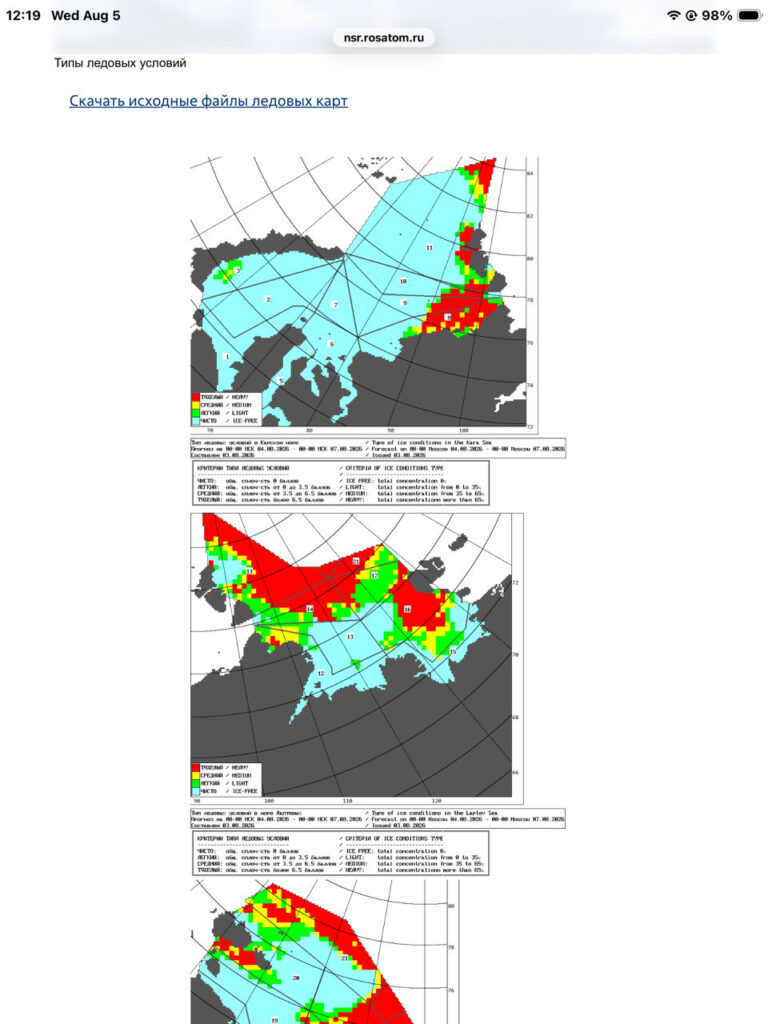
I’m on “ice watch” in Hammerfest, Norway, sitting here on my sailboat Phywave. My route through the Russian Arctic is currently blocked but uncharacteristically extensive, stubborn ice in the Vilkitsky Strait (shown by that big patch of red in the strait). The NSR guys I’m working with don’t have a forecast date for when it will open up, so until then, I’m biding my time in Hammerfest.
After a catastrophic failure of my compass and associated autopilot failure that forced me to retreat to Iceland to figure it out, the voyage from Husavik to Hammerfest went pretty smoothly with the compass and autopliot performing well.
As always, the weather was a challenge with one particularly large low pressure system I had to navigate around to the south before turning back north again. The southerly winds were so fierce, 30 – 40 kts, when I arrived in the Hammerfest channel in the middle of the night, that instead of trying to enter the harbor and marina then, I decided to heave-to out in the channel until the winds weakened several hours later. At around noon on Saturday, August 1, I was finally able to get in and tie up in the small 8 berth marina they have which is literally right in the center of town with many nearby restaurants and shops. After making a phone call to arrange to meet someone to complete entry formalities at the police station, which is normally closed on weekends(!), I reviewed my tasks list while having lunch across the street.
One thing I haven’t mentioned before is the screwed up whisker pole I use to wing out my genoa headsail when sailing downwind. One end of the pole is attached to a bracket called a mast car that slides up and down a T-track bolted to the front of the mast. When normally stowed, the pole is vertical in front of the mast. To deploy it, I pull the bottom end of the pole forward until it’s more or less horizontal and then attach it to the clew of the genoa. When I do this, the top end of the pole with the car slides down the track. The mast car is supposed to have plastic inserts that let it slide smoothly along the track. At some point, I don’t really know when, those inserts fell out or were worn away so that there was metal on metal as the car slid on the track. Worse, without the plastic inserts, the car was too loose on the track and would fall off so the rig fundamentally was not working. The only fix was to get replacement plastic inserts, about $25 a pair, but $250 for express shipping to Norway, to Vardø in this case.
Which brings up my conundrum when I changed my Norway destination from Vardø to Hammerfest. In addition to whisker pole car inserts, I had a couple of other things shipped to Vardø, including a new Spade S140 anchor coming from France. As I mentioned in a previous post, I had serious problems with the Rocna Vulcan anchor hanging so low in rough seas, catching waves, and yanking on the windlass. I finally got so disgusted with it, I decided to replace it with a new Spade anchor, an S140 30 kg model, one size bigger than 25 kg model I had before on my solo 7 continents circumnavigation voyage. But at the time I ordered it I still had Vardø as my Norway destination so had it shipped there.
There are direct flights from Hammerfest to Vadsø, an hour’s drive from Vardø, but you don’t bring a 30 kg anchor (in two heavy packed boxes – fluke and shank) as checked luggage on the small commuter plane making that run. The alternative was to rent a car and drive to Vardø to get it, which I did, 7 hours each way across the roads of northern Norway threaded around fjords and across windswept, treeless, highlands. Anybody who knows me knows I’m steely-eyed endurance driving fool but even that was a lot for me – to Vardø on Monday, back to Hammerfest on Tuesday. I had a nice night at the Vardø hotel (the only hotel) and a delicious dinner – their dish named “Cod is Great”.
After I saw Vardø, I was immensely glad I changed to Hammerfest as my jumping off point for the Russian Arctic, a choice I should have made in the first place if I’d done more effective research. Vardø is a sad, dilapidated little fishing village with one hotel (a few guest houses as well) three or four small restaurants with limited hours, and a fishing fleet. The thought of Phywave being in a berth on the bouncing dock along with the fishing boats, with a long walk to the very few places in the town like the grocery store, was a really depressing thought, especially compared to where Phywave is in Hammerfest. Even the fuel dock in Vardø was a rundown set up. It didn’t help that the wind was blowing 30 kts with driving rain when I arrived – a terrible first impression. Well, at least I got good at typing the “o” with the line through it. Just hold your finger down on the “o” and a bunch of alternatives will appear you can choose from.
So Hammerfest. I fixed the whisker pole, installed the new Spade anchor (I’ll probably unceremoniously dump the Vulcan at sea), and am now thinking about installing a Furuno SCX-20 GPS compass which is staring at me from a box on the galley counter. After the fiasco with my compass in Iceland, several experienced high latitude sailors said to get a GPS compass. A GPS compass uses an array of GPS antennas to establish direction so it’s immune to magnetic or electrical interference, but like any GPS system, needs a reasonably clear view of the sky. Until now, I didn’t even know GPS compasses existed. Another failure on my part in my inadequate preparations for this voyage which have become apparent in a number of ways.
The Navico dealer in Iceland connected me with a dealer in Norway who, extraordinarily, was able to find this compass in stock and have it shipped overnight to me in Hammerfest. It plugs right into the NMEA2000 backbone network and should show up along with the Precision 9 compass as a source I can select for heading information. I’m not sure how and where I’m going to mount it. It’s a waiting-on-ice project.