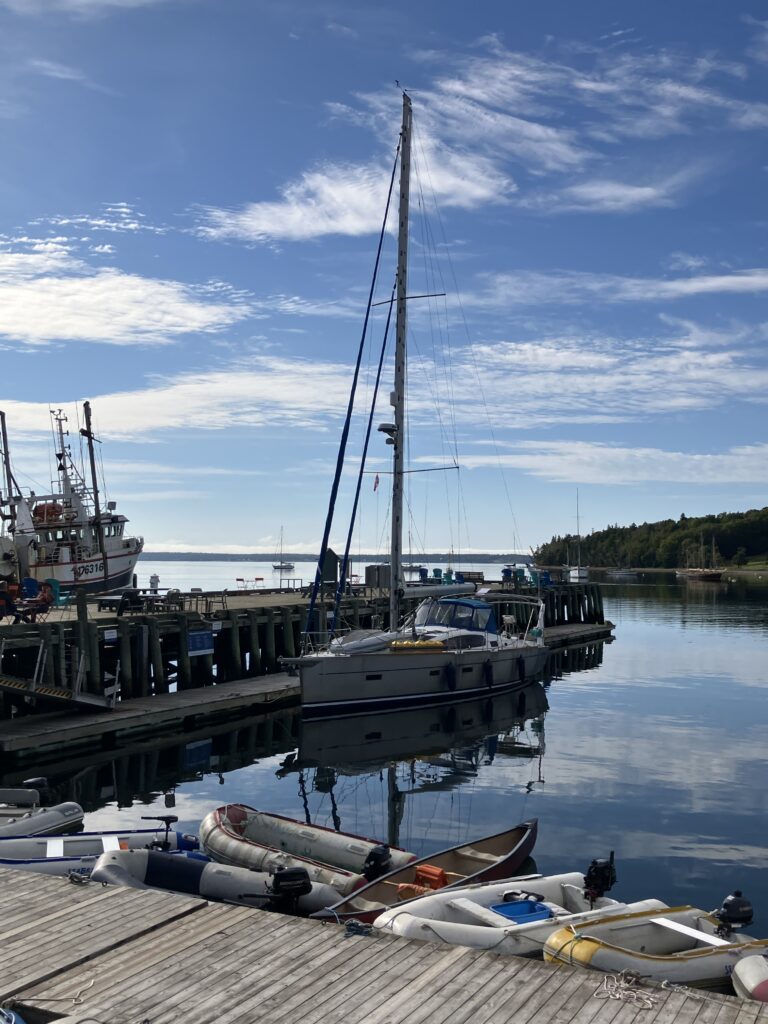
I left Lunenburg at around 0900 local time on Saturday, September 19. Compared to the passage from Norway to Lunenburg, the passage onward to the US from Lunenburg was pretty sublime. I actually had a sunny day of sailing with favorable winds. There were also periods of calm when I’d motor to keep making tangible progress.
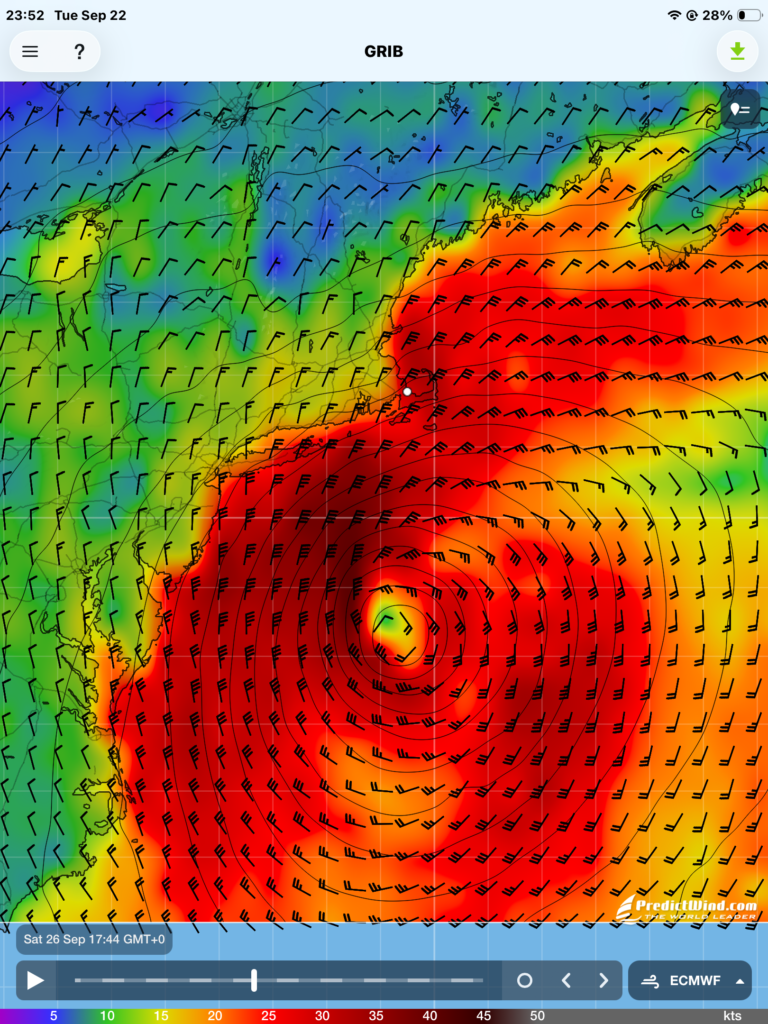
The thing that primarily occupied my planning was the forecast wind storm, or Nor’easter, as east coast people call it. It was forecast to reach maximum strength the weekend of September 26, but before that winds and waves of considerable strength were forecast for my route from Lunenburg to Cape May in Delaware. Cape May is at the mouth of the Delaware River and the point where I would leave the ocean and proceed upriver to the Chesapeake-Delaware (CD) canal that connects the river to the north end of Chesapeake Bay. Once through the canal, its straightfoward to proceed south down the bay to Annapolis.
Not being able to make it to Cape May in one passage, I began looking for marinas in New England where I could wait out the Nor’easter. I considered marinas in Portland, Maine, and Portsmouth, New Hampshire, but decided it would be most efficent if I went further south so my route to Cape May after the storm passed would be shorter. Not having any personal knowledge of any of these places, I had to rely on various websites in my search. I finally settled on the Sandwich Marina in Sandwich, Massachusetts. It’s a small marina located at the east end of the Cape Cod Canal, a canal which cuts across from Cape Cod Bay to Buzzards Bay, thus avoiding going all the way around the ocean side of Cape Cod, and also avoiding the Nantucket Shoals. Knowing boat shelter would be in high demand for the storm, I felt lucky to book a slip here through the Dockwa website for September 22-28.
As I’ve often done, I substantially slowed the boat approaching Cape Cod so I would cross Cape Cape Bay and arrive at the marina in daylight. The forecast said the winds at the marina would be about 12 kts. Wrong again.
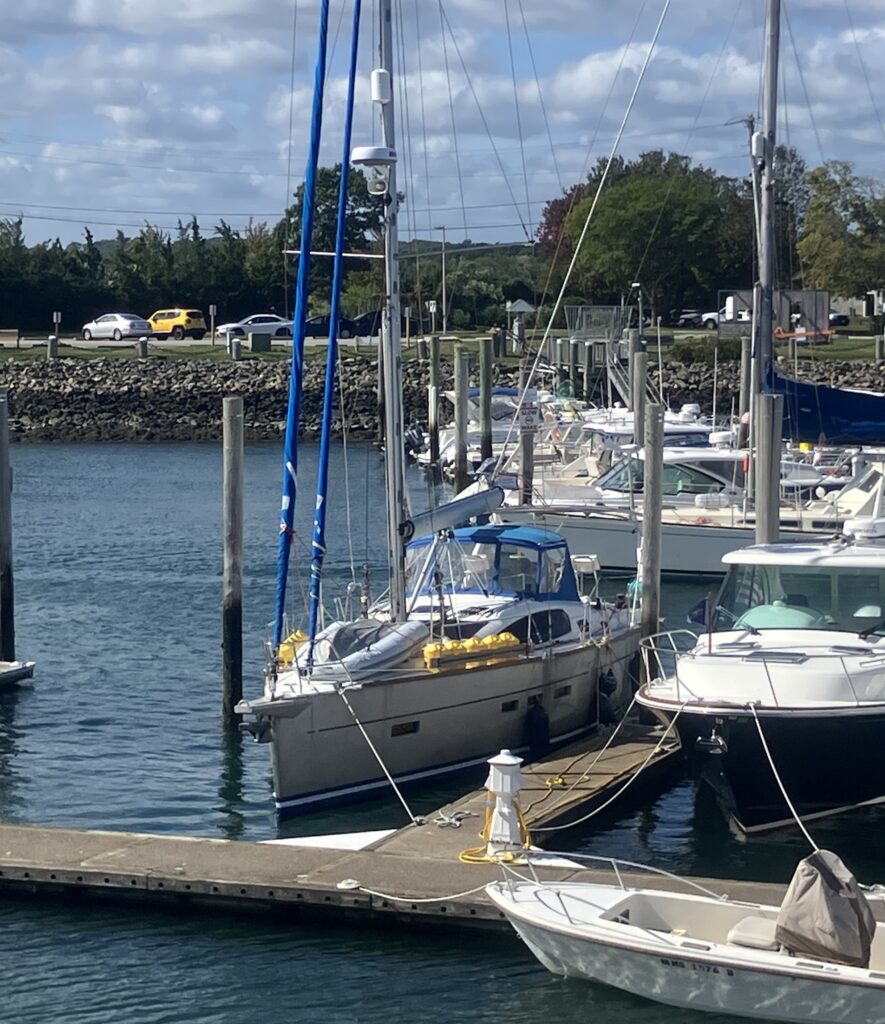
Crossing the bay south I expected the winds to diminish from 20-25 kts to 12 kts but they didn’t, instead staying the same strength; I noticed one gust at 28 kts. I now faced the prospect of having to drive my boat into a slip in a small marina with a 20+ kts crosswind. Phywave has a lot of freeboard (exposed hull above the waterline) and a large dodger giving it significant so-called “windage” which makes it more prone to be pushed sideways by the wind compared to boats with a more streamlined profile.
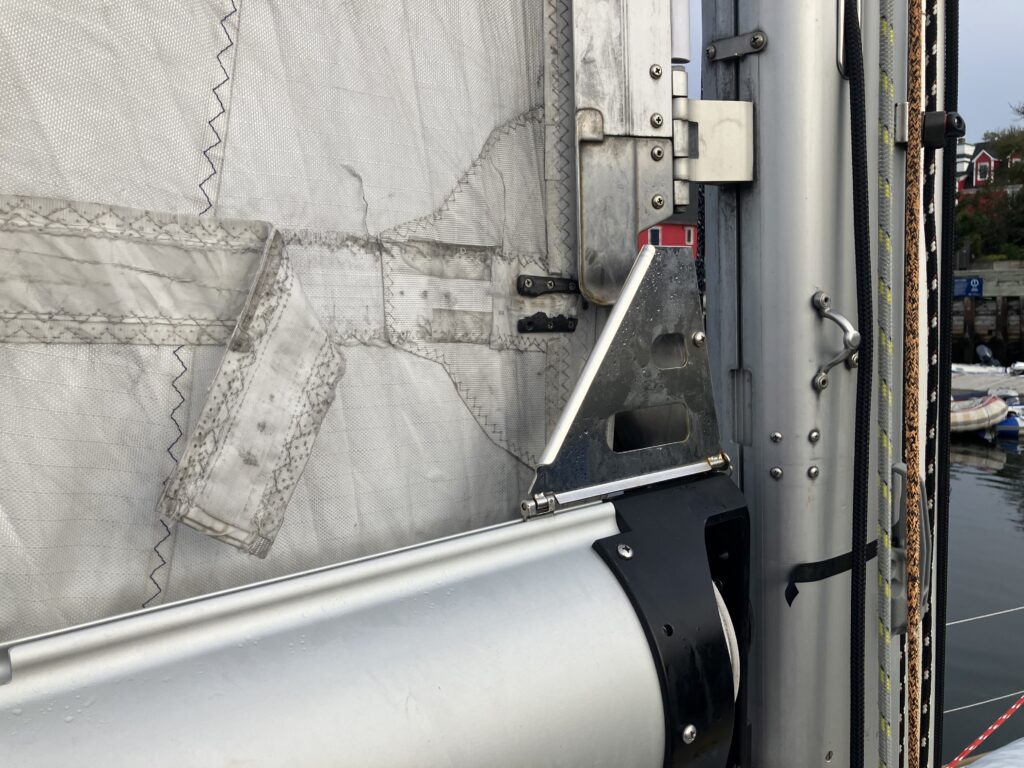
As I usually do, I called ahead to the marina with the VHF radio and asked that dockhands meet me to take my docklines because I’m sailing solo. Given the winds, and my relative inexperience with docking under such conditions, I was really concerned about making it into the slip. The situation was further aggravated because my bow thrusters were not working, something I discovered when coming into Lunenburg. The motor runs but I was getting no sideways propulsion, probably indicating the prop blades were gone. I had last used them leaving Hammerfest and they worked fine there so apparently the bow thrusters prop blades were another casualty of the passage to Lunenburg, like the battens and masthead antenna.
I resorted to the only technique I knew – make the turn into the slip going fast with a lot of power on, like I intend to smash the boat right through the dock. Once in the slip go to maximum reverse power to stop the boat before it actually does crash into the dock. It worked out better than I expected, but once in the slip getting it secured with the help of the dockhands took some work because the crosswind was pushing Phywave away from the finger dock where it was supposed to be tied. We finally got it done but I’ll probably double up on the dock lines and add snubbers before the maximum winds hit this weekend.
Sandwich Marina is in a good location with a couple of fine restaurants on either side which I’ve already visited. There is a shopping plaza a 10 minute walk away with more restaurants and a typical mega American grocery store with everything you could possibly want, quite a contrast to the small, but adequate, grocery stores I see in most foreign locales like Hammerfest and Lunenburg.
Clearing Customs and Immigration when arriving in the US in a private pleasure boat from a foreign port has never been easier. The CPB ROAM app is designed to let you arrive pretty much anywhere, not just at a designated Port of Entry and show up in person at a Customs facility . After securing Phywave at Sandwich Marina, I got on the app and filled in the details about my boat, my arrival location, and me personally as the ship’s master and only person aboard. I hit the button to submit the info to a CPB officer for review. Thirty minutes later I got a message that my entry into the US was approved. I used the same app when I arrived in Fort Lauderdale in 2025; it was just as easy then.
Unfortunately, it appears you can’t use CPB ROAM when arriving in the US by private aircraft. The last time I flew my plane into the US from another country (Canada) was in 2019. I had to fly to a particular airport and make an appointment by phone with a Customs guy to meet me there. Apparently, that process is still necessary. I don’t see an obvious reason CPB ROAM couldn’t be used for aircraft arrivals, allowing you to basically fly in to any airport, not just a designated Customs airport, and use CPB ROAM to report that arrival.