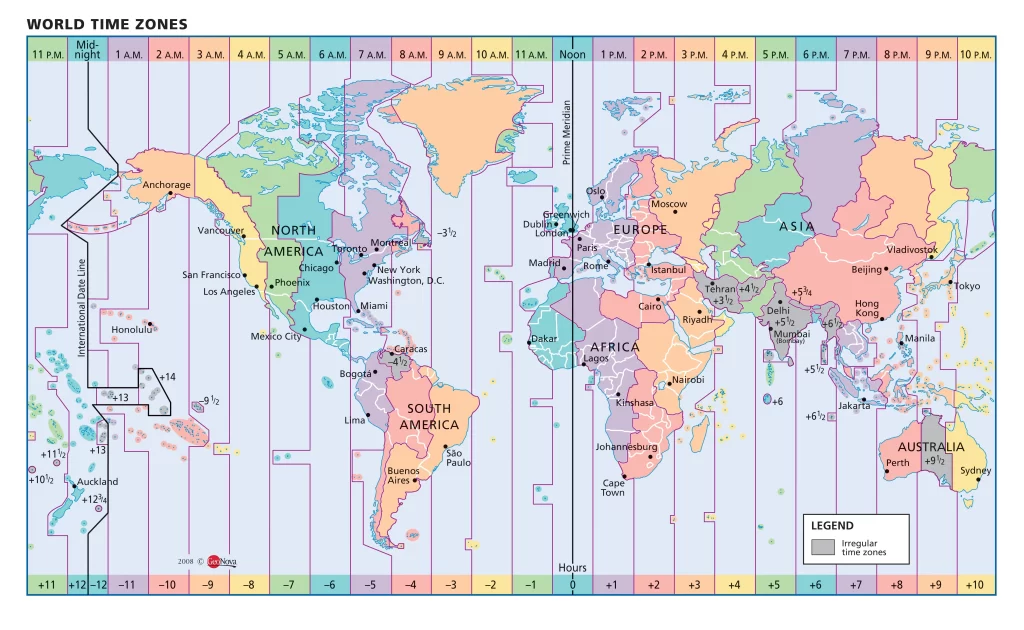
If you think crossing 180 degrees west longitude is crossing the international dateline you’d pretty much be wrong. The international dateline is a politically-hatched snake that slithers its way north-south across the Pacific Ocean. For example, in Tonga (officially, the “Kingdom of Tonga”) local time is GMT+13. The higher math I know says that’s the same thing as GMT-12. Yes, but Tonga has very close ties to New Zealand. In fact, the shop and restaurant owners I got to know in Neiafu complained they couldn’t find local workers because they all went to New Zealand to pick fruit! Tonga wants to be on the same day as New Zealand so they invented GMT+13.
Then you have places that aren’t satisfied with being an even hour difference from GMT. They have half hour (Marquesas) or even quarter hour differences. There can be no rational explanation for this except sheer bloody mindedness.
When I was hitchhiking around Africa in 1975 with backpack and guitar I got to know Swahili time in Kenya, on the equator. Zero o’clock was when the sun rose, consistently at about the same time. I remember bus schedules written in chalk on blackboards listing departures in Swahili time, which itself was an optimistic fiction because a bus rarely left until it was full of people, luggage, livestock, etc. It would drive all over town scooping up willing passengers to fill it.
On the boat I keep clocks and the log in GMT, except my watch which is set for my best guess at a local time. The weather forecasts are all in GMT so I need to convert to a local time to understand if the bad weather is going to hit me in the middle of the day or the middle of the night. Otherwise, it doesn’t matter much what time it is. The sun comes up then goes down, called daytime, the rest being nighttime which is routinely forecast to be dark. Then there’s the morning you wake up and realize it’s been tomorrow since yesterday.
I never flew on the supersonic Concorde but I’m told you could take off from Paris at 10 am and arrive in New York at 9 am. If you kept going around the world that way you’d never get old. We need to bring that back.
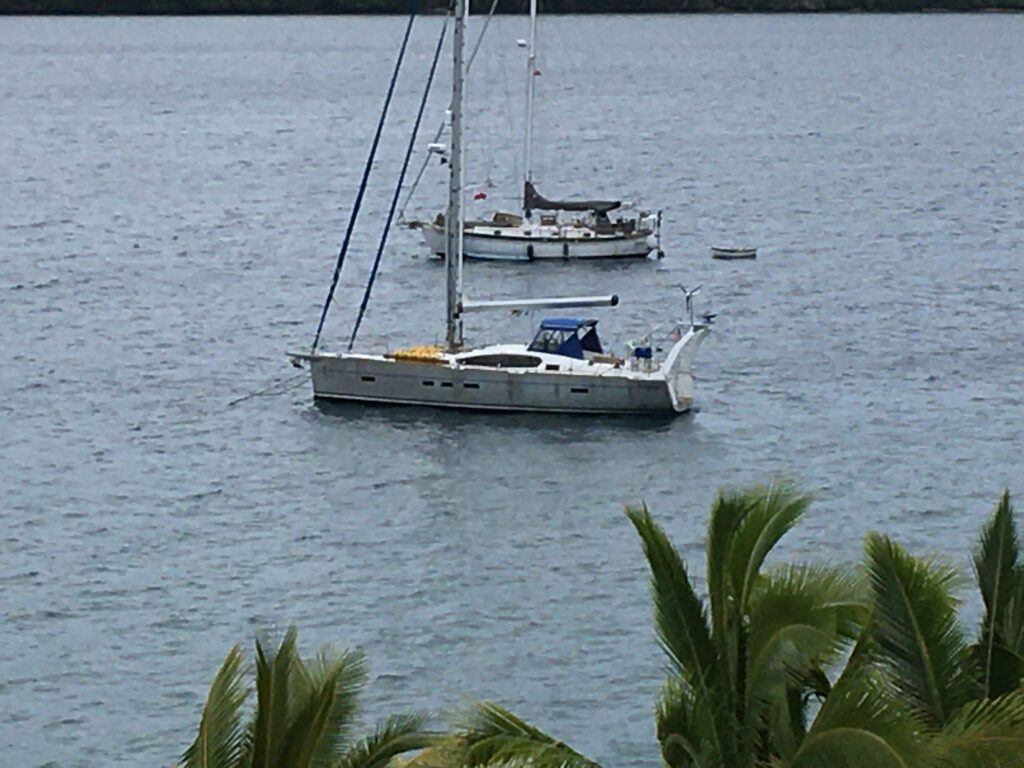
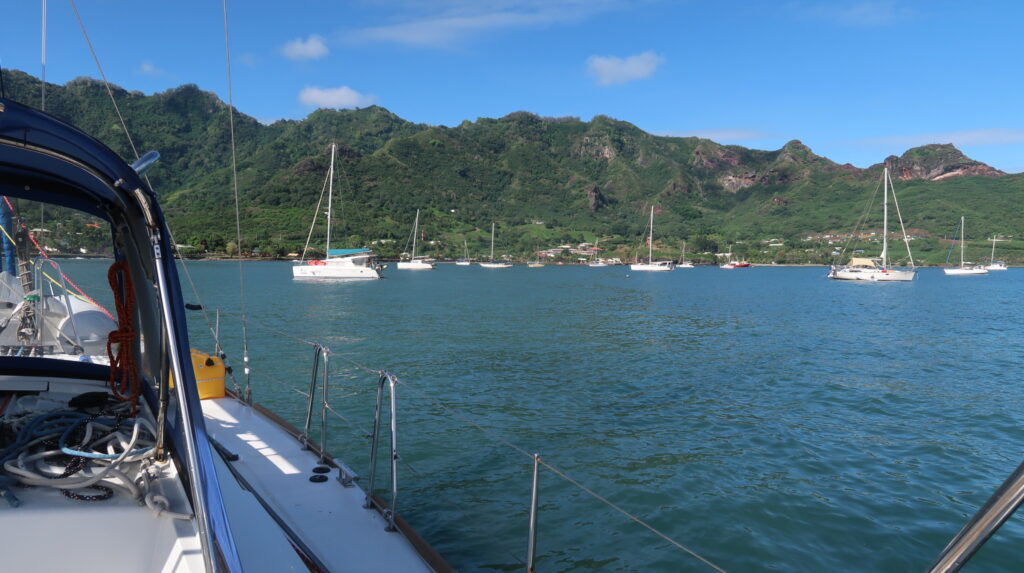
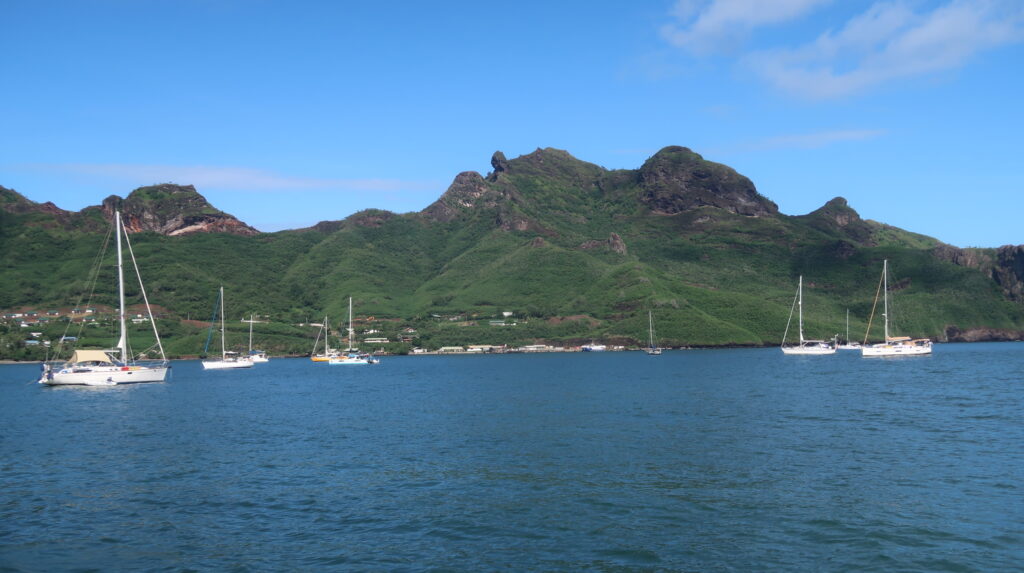
I’m including a few more photoss from Vava’u as I leave there and head due west toward Vanuatu, crossing 180 degrees west longitude into the Eastern Hemisphere for the first time in Phywave.
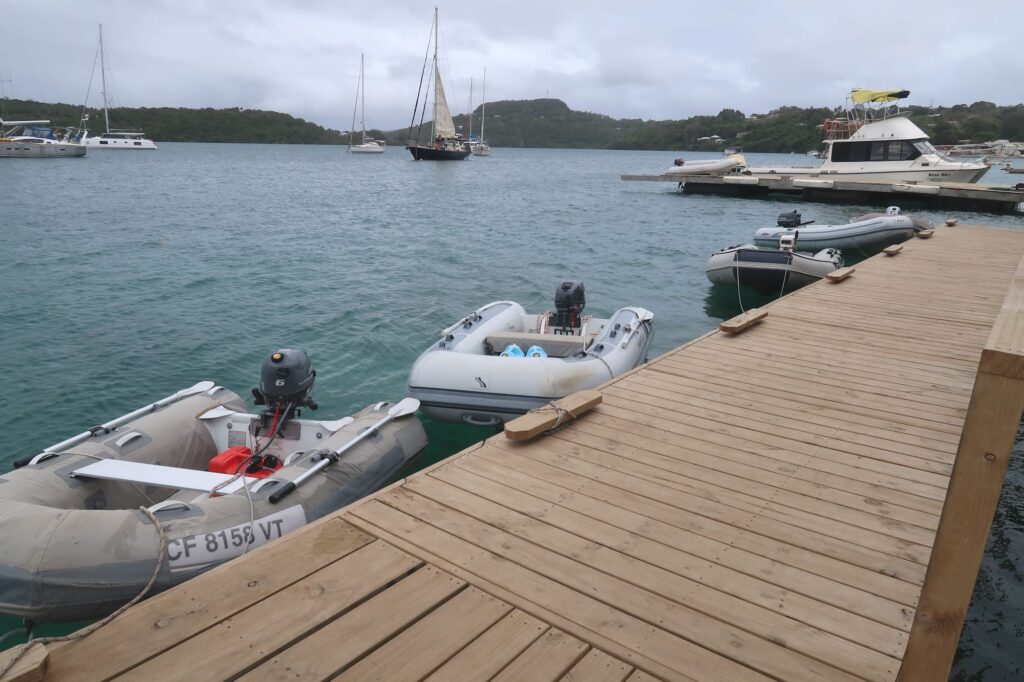
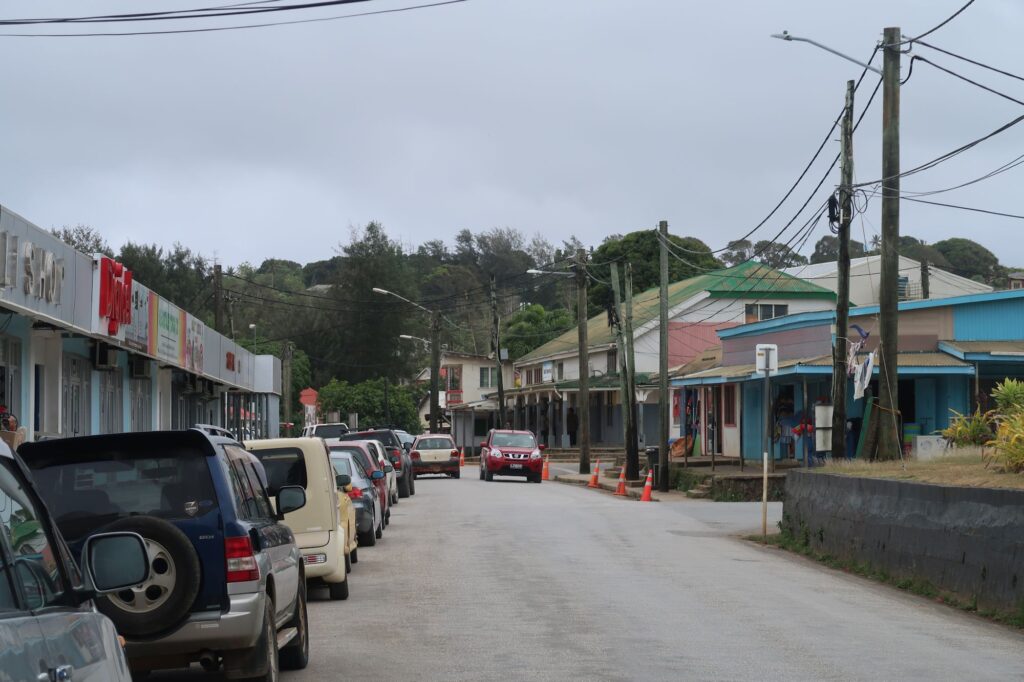
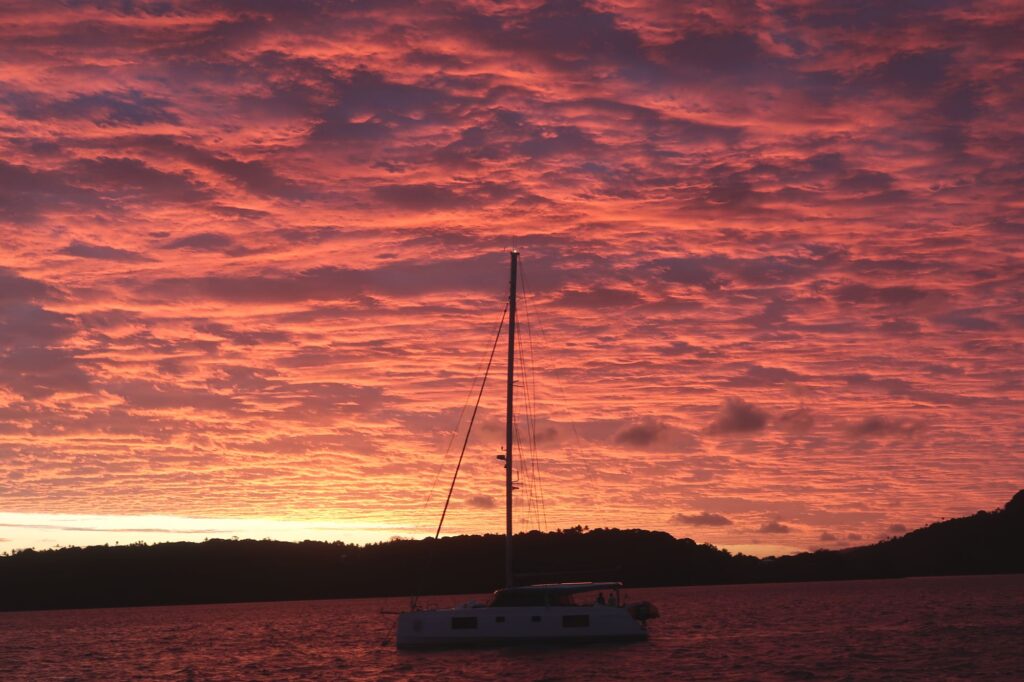
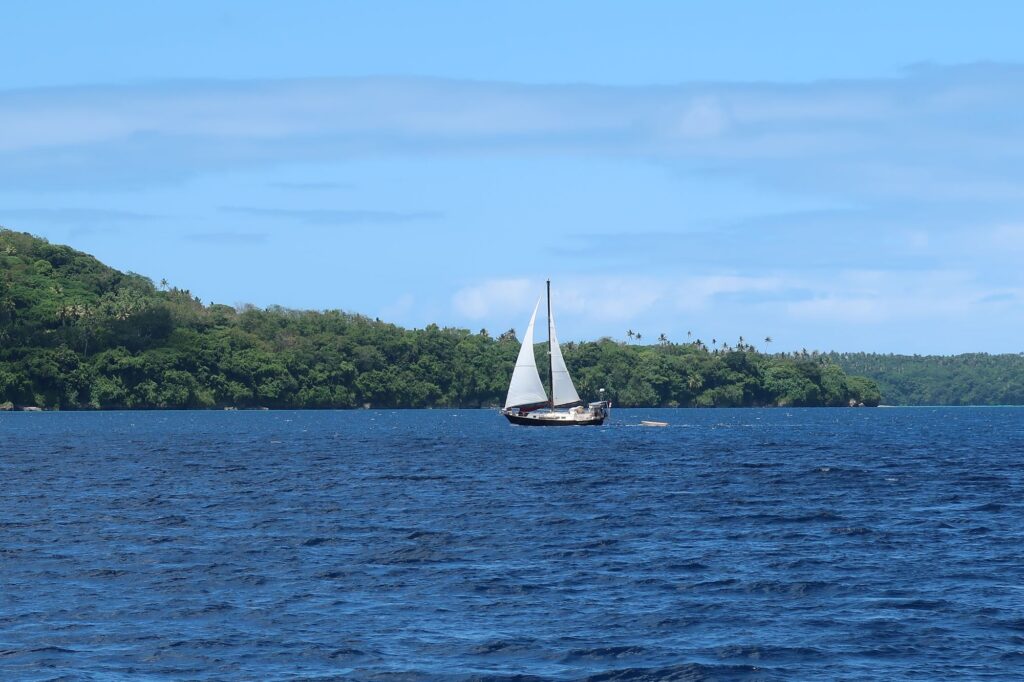
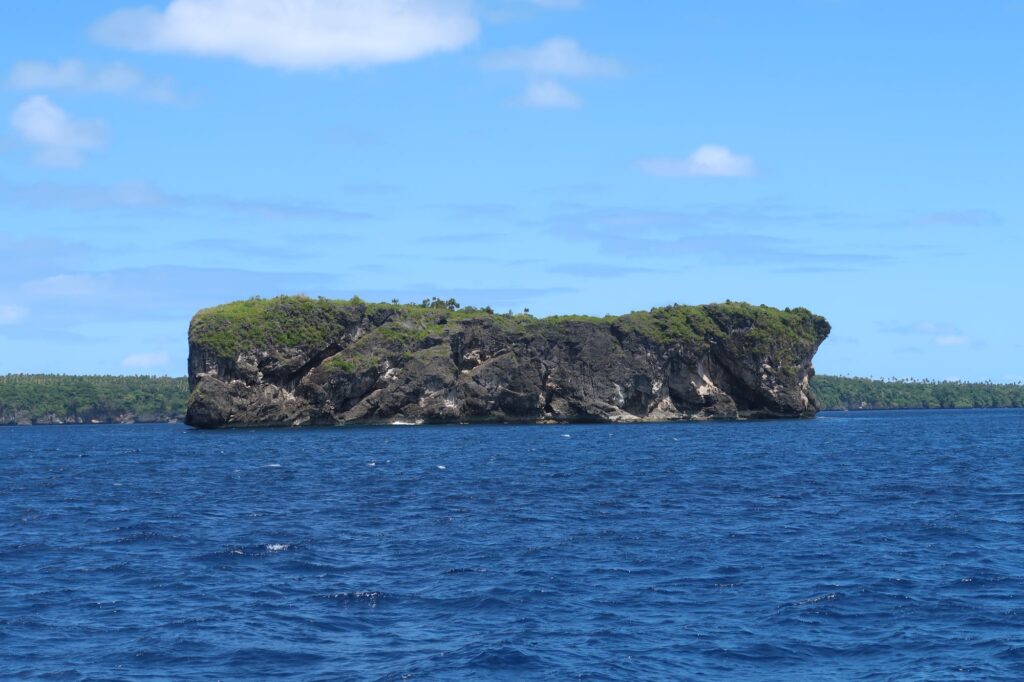
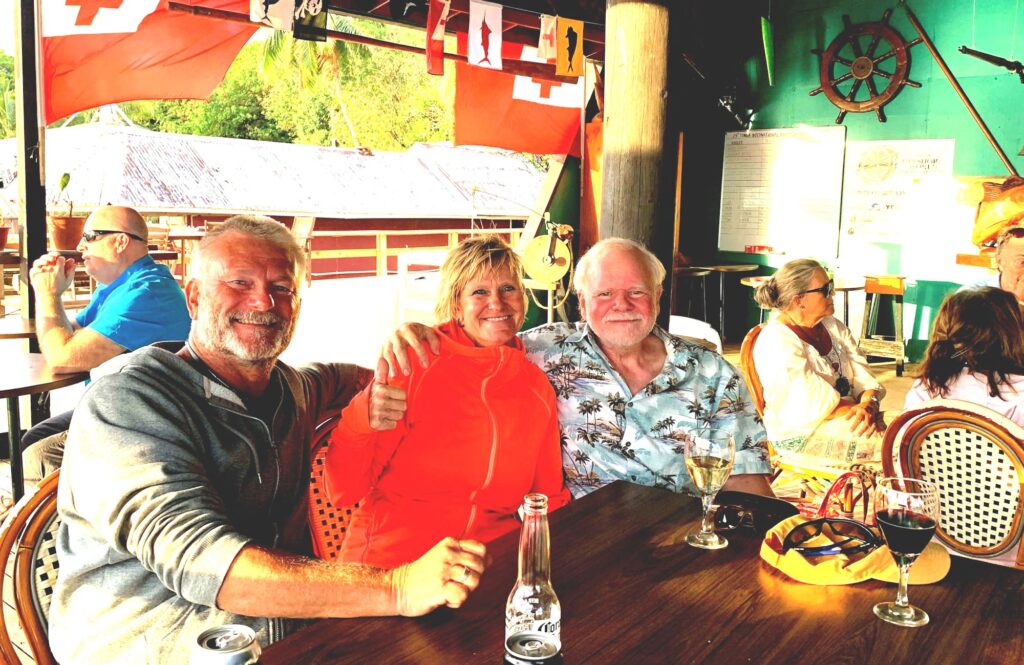
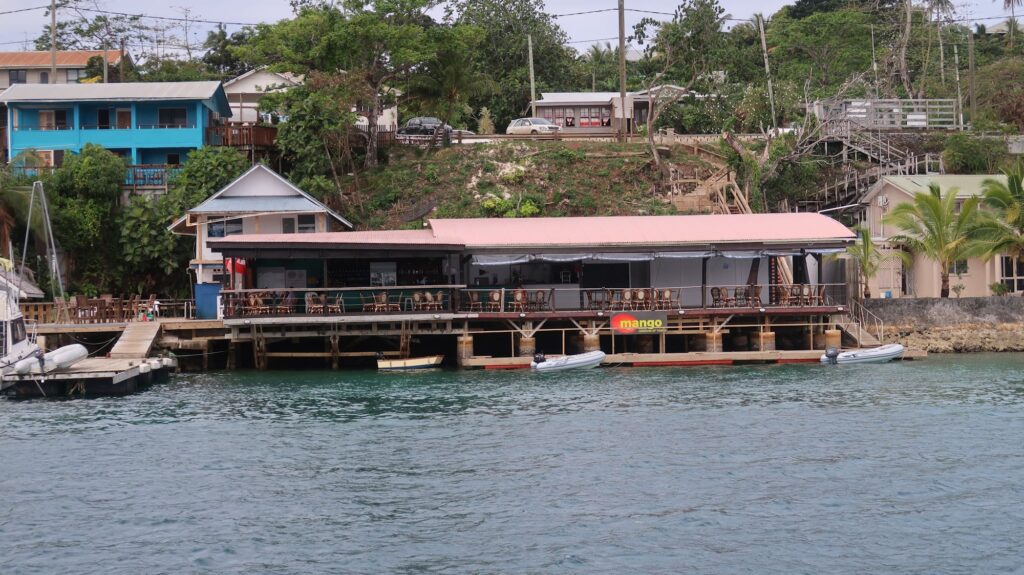
The dinghy dock at Mango Cafe with half of Phywave on the left edge of the photo in the distanceMain street in NeiafuA brilliant sunset from my mooring locationA yacht sailing to Neiafu as I was leavingOne of the many small islands in the Vava’u archipelagoWith my Swedish friends Lars and Susanne from s/y Sea Wind at the Mango Cafe
After an unplanned stop in Papeete for 10 days to have some essential repairs done on my mainsail, I had a fairly uneven crossing to Vava’u in Tonga – periods of no winds followed by 4.5 meter waves with 8 second intervals and 30-35 knot winds. To take a break from these conditions I heaved-to for a while and let the boat drift westward.
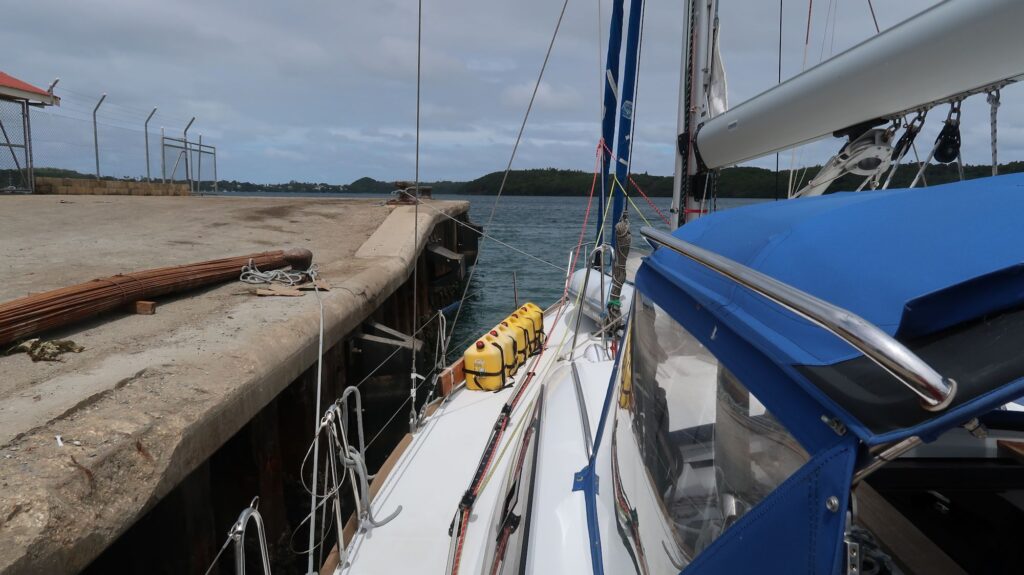
Wind and rain greeted me as I finally maneuvered through the outlying islands of the Vava’u group into the narrow channel that leads to the main town of Neiafu. After tying up to the commercial dock to spend a couple of hours going through the Customs and Immigration clearing-in process I was faced with finding a place to put my boat. Neiafu is located on Refuge Harbor, a well-protected but fairly deep harbor with abundant coral heads making anchoring there a tricky proposition.
To accommodate the many yachts that come here, a few companies have installed a number of moorings. Moorings are basically very heavy weights, like a big block of concrete, sitting on the bottom. The blocks are attached to heavy duty lines with loops that are pulled to the surface by a buoy or float of some kind. Attaching the mooring lines to the bow cleats on a boat provides very secure holding even in strong winds, assuming the mooring is in good condition (they need periodic maintenance).
I faced a couple of issues after clearing-in. I contacted the 2 companies by radio that have essentially all the moorings and both told me they were all taken because last week was the Vava’u Blue Water Festival and a lot of boats showed up to participate. The second problem is that it can be difficult to pick up the moorings lines when sailing solo, especially if it’s windy. I have to maneuver the boat as close as I can to the mooring buoy, then leave the helm and try to fish the mooring loops out of the water with a boat hook while the boat is now drifting way because no one is at the helm. Of course, after grabbing the mooring loop you have to be ready to quickly get it tied to something on your boat. Just trying to pull on it with your boat hook is good way to lose your boat hook. I have a clever hooking device I can put on the end of my boat hook with a line attached that solves that problem, but not the problem of the boat drifting away. I’ve always been able to grab a mooring with the boat hook eventually but it may take several passes with the boat to get it – a very frustrating process.
Fortunately, some long-time friends I had never actually met solved both problems. I’ve followed a Swedish couple, Lars and Suzanne Hellman, on their boat Sea Wind for more than 18 months after I first spotted them going to Antarctica in 2022 and wanted to keep track of where they anchored. Since then we’ve traded many emails and I’ve followed their posts on Facebook and YouTube. I knew they were already on a mooring in Neiafu so I sent them a quick email asking if there were any open moorings near them. Lars immediately came back and said he was headed in to town in his dinghy and would look around for open moorings on the way. 15 minutes later, as I was pulling away from the commercial wharf, Lars came along side in his dinghy and said he found a great mooring very close in to town that just opened up. He not only led me to it, but when we got there he fished the mooring loops out of the water and put them around my bow cleats. The boat was hooked up and secure! Lars and Suzanne are amazing, helpful people who assist many cruisers, organize events, etc.. I had them over to my boat that evening and opened a great bottle of red wine I bought in the Algarve I’d been saving for a special occasion. They had preceded me to Puerto Williams, Antarctica, and Puerto Montt so we knew a lot of the same people in these places and had many stories about similar experiences.
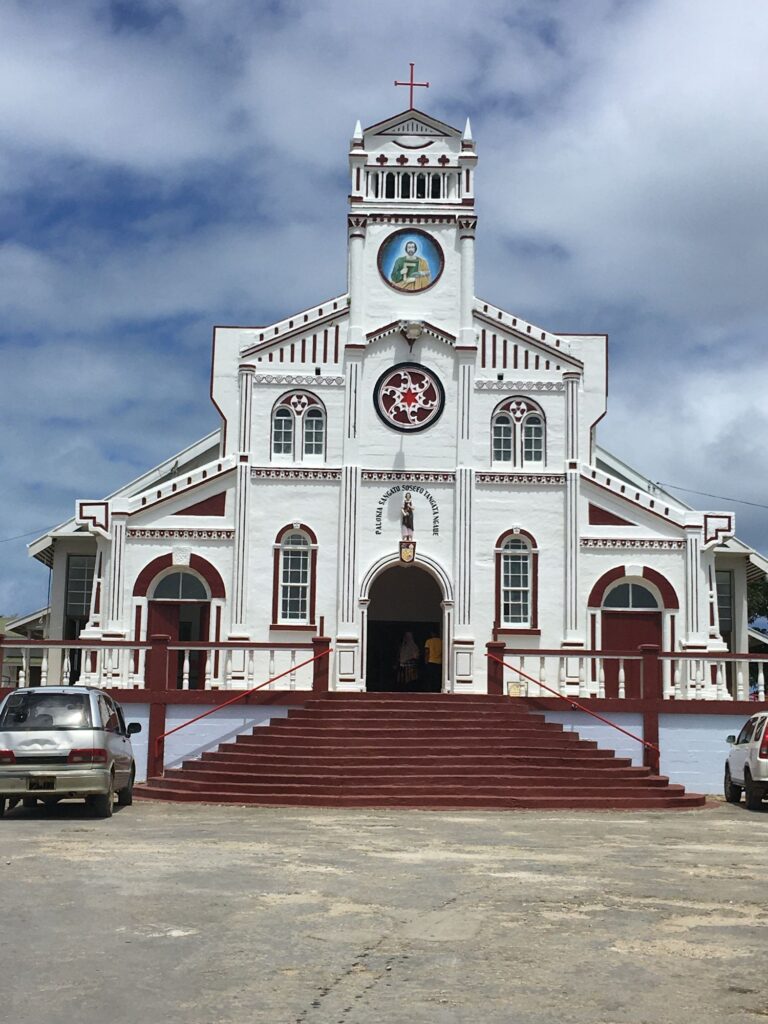
This morning, Sunday, October 1, I was relaxing in the boat’s cockpit with a cup of coffee when I heard music coming from the nearby Catholic Church. The beautiful voices of the choir had found their way across the water to me and Phywave, a wonderful start to a peaceful morning and my first full day in Tonga.
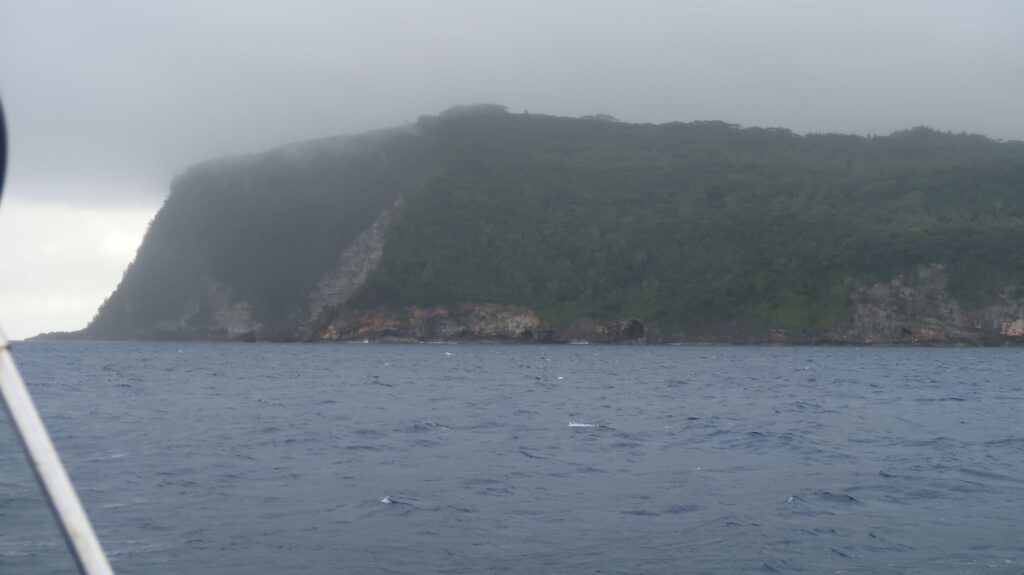
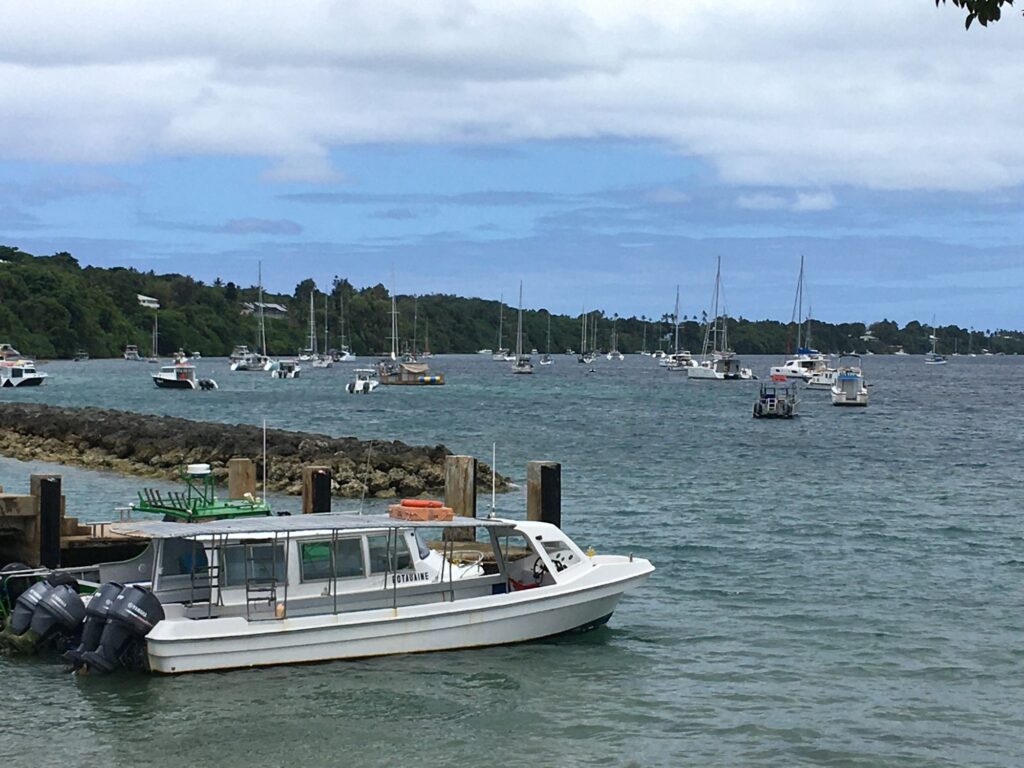
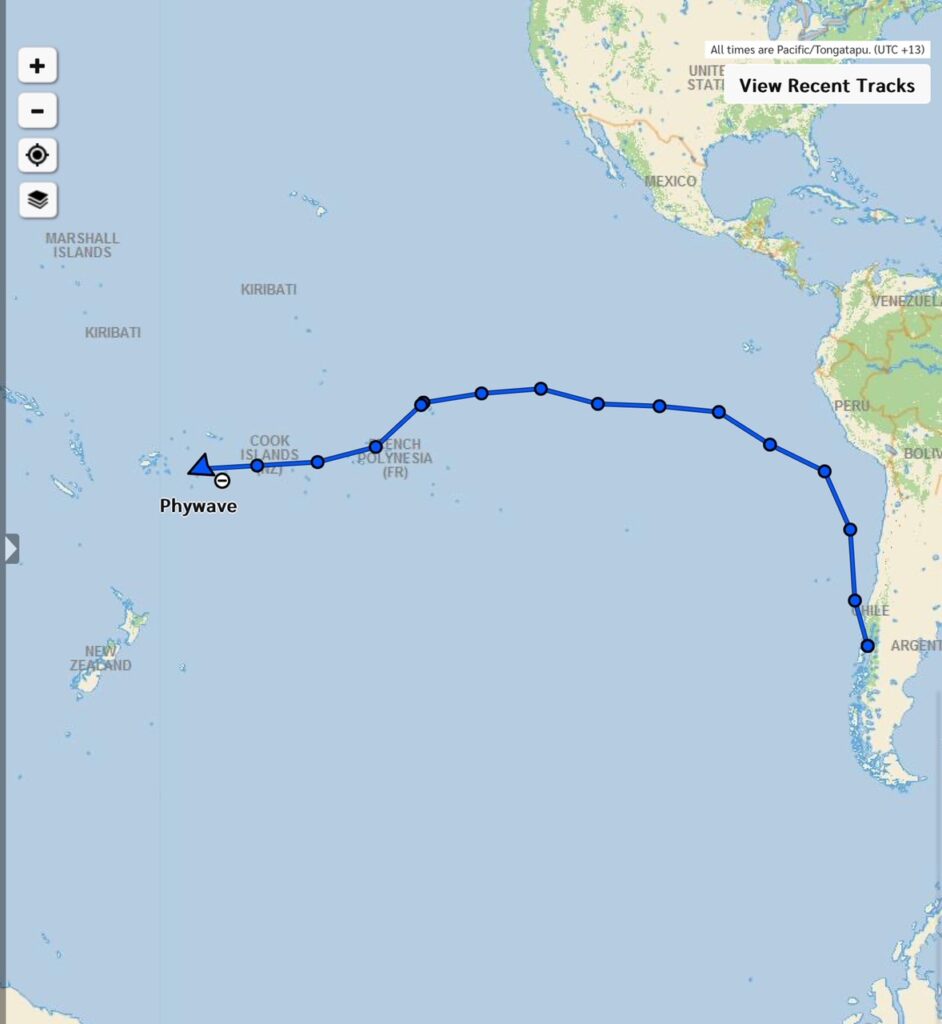
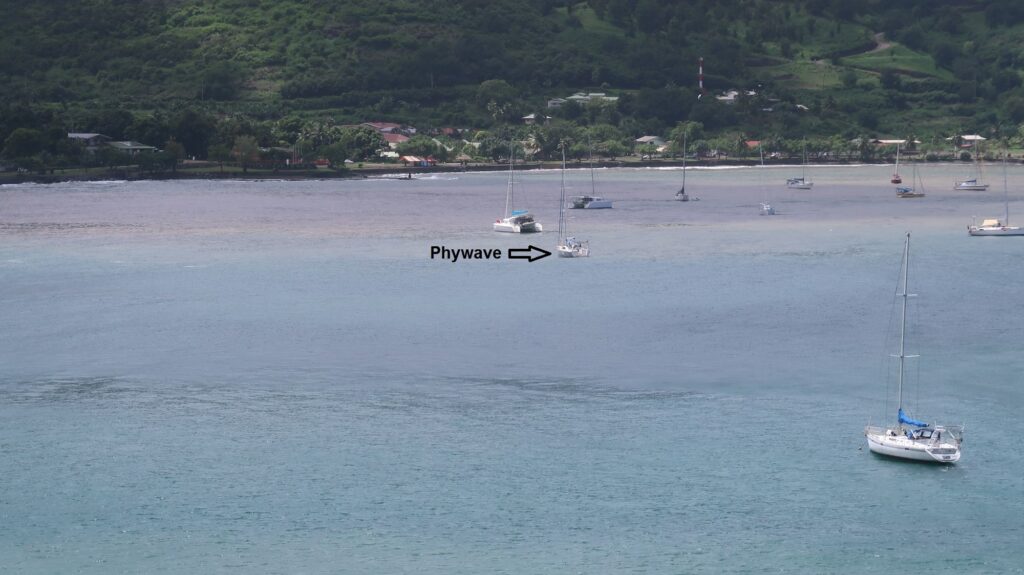
Vava’u headlands through the mist and rainPhywave tied to the commercial dock for clearing in.Mango Cafe with its dinghy dock from my mooring locationCatholic Church in NeiafuSmall boat harbor and mooring field filled with boats in the distancePhywave moored just offshore in front of the Mango CafeRoute across the Pacific from Puerto Montt to Tonga
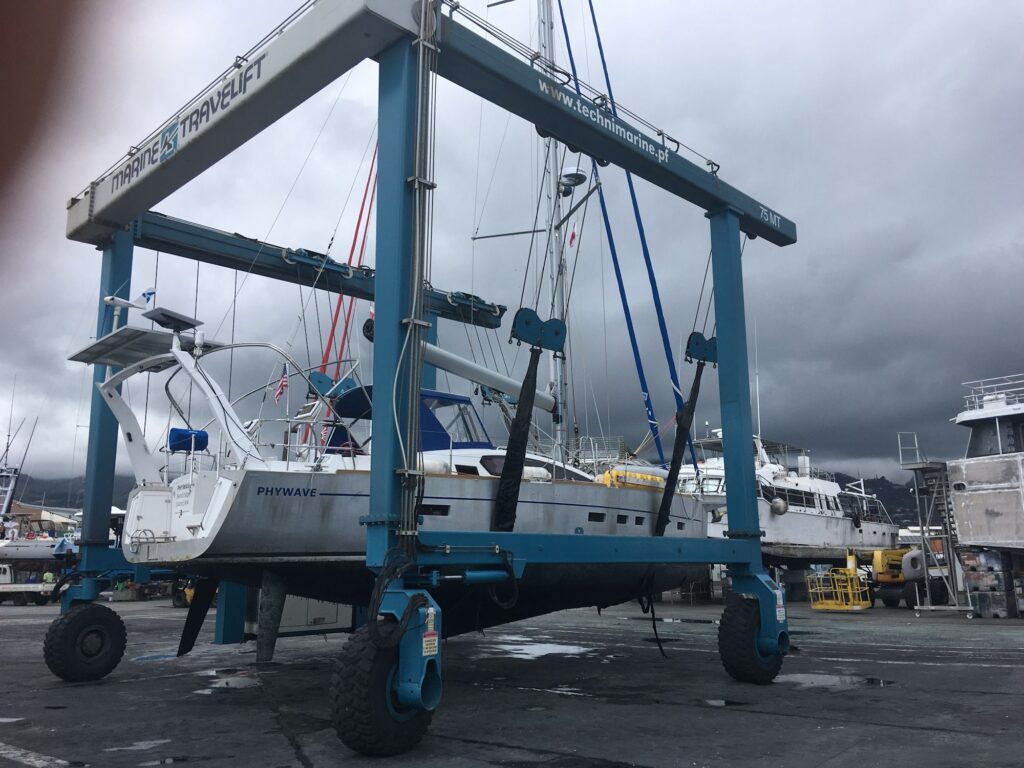
With no confirmed marina space available, I decided to have the boat hauled out and put on the hard so I could remove the mainsail for its repairs. This might have been possible with the boat anchored but very difficult. It’s a big sail so I normally have one other person to help me take it off and put it back. Doing it alone with the boat at anchor would have taken 5 times as long to flake the sail once it was off the boom. It also would have been risky – a sudden gust of wind could have pulled the sail off the boat and into the water where recovery would have been nearly impossible. Even if I got it flaked and tied in a bundle I’d have to carry it ashore in the dinghy. Of course, to put it back after repair would have been the same risky process in reverse. Though expensive, with no marina space available hauling the boat was the only viable option. I did take advantage of it by having the bottom power washed. It’s amazing how fast sea life latches onto a hull.
It really is not comfortable to stay on the boat when it’s out of the water – you can’t use any sink drains because normally they discharge straight into the water. Boatyards are also hot, noisy, dusty places with sanding, scraping, and painting going on all day. Hanging out there is no fun.
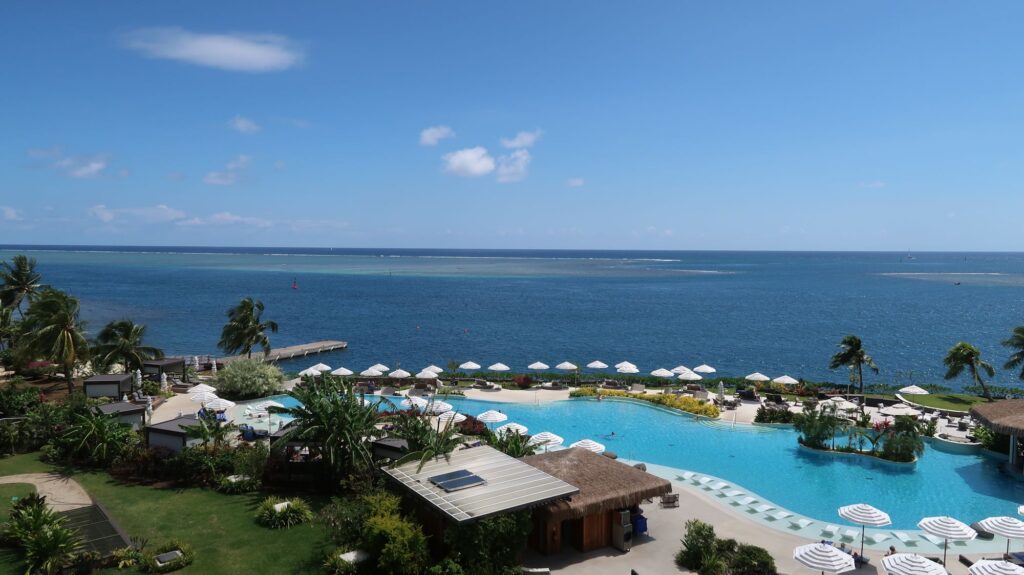
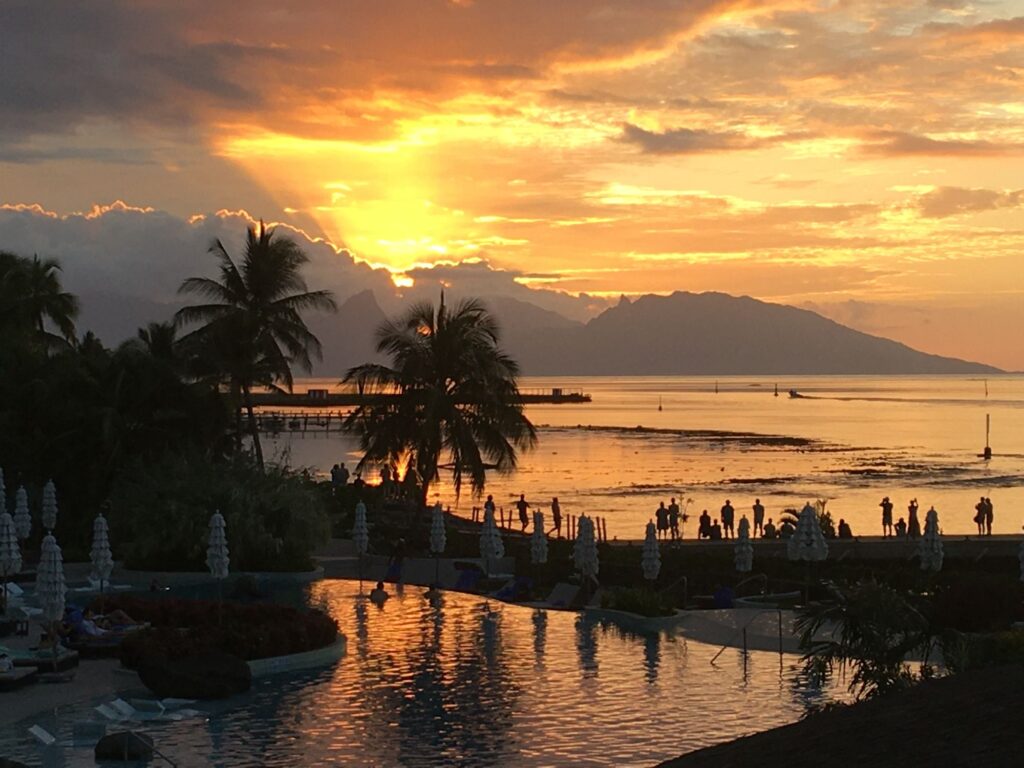
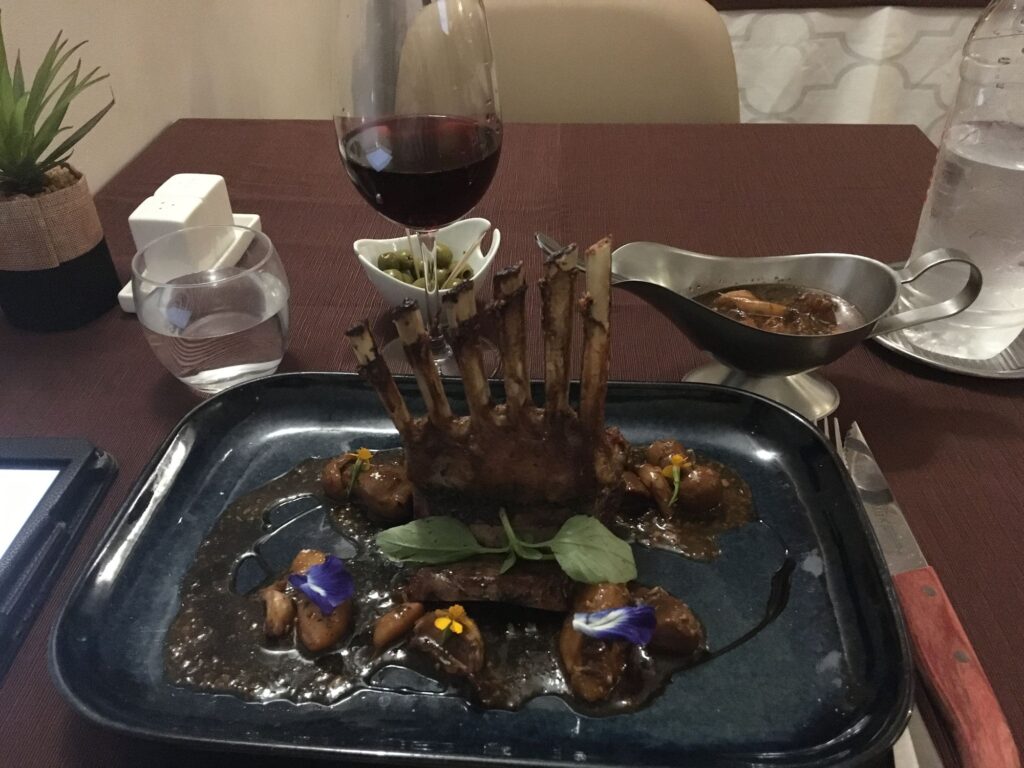
Given all that, I booked a room at the Hilton Tahiti on the waterfront, a pretty nice place and convenient to where I needed to go in Papeete. It was connected to a shopping mall with a huge Carrefour supermarché where I bought everything I wanted to provision the boat for passage all the way through to Australia. It was also just 10 minutes drive from downtown Papeete with a wide variety of good restaurants. The pool and sunset views from the hotel over nearby Moorea were pleasant distractions from everything happening with the boat, my schedule and my route. The Hilton was the relaxing, restorative interlude I wanted at Nuku-Hiva but didn’t get. A hot shower every day? It’d been months since I had anything close to that luxury.
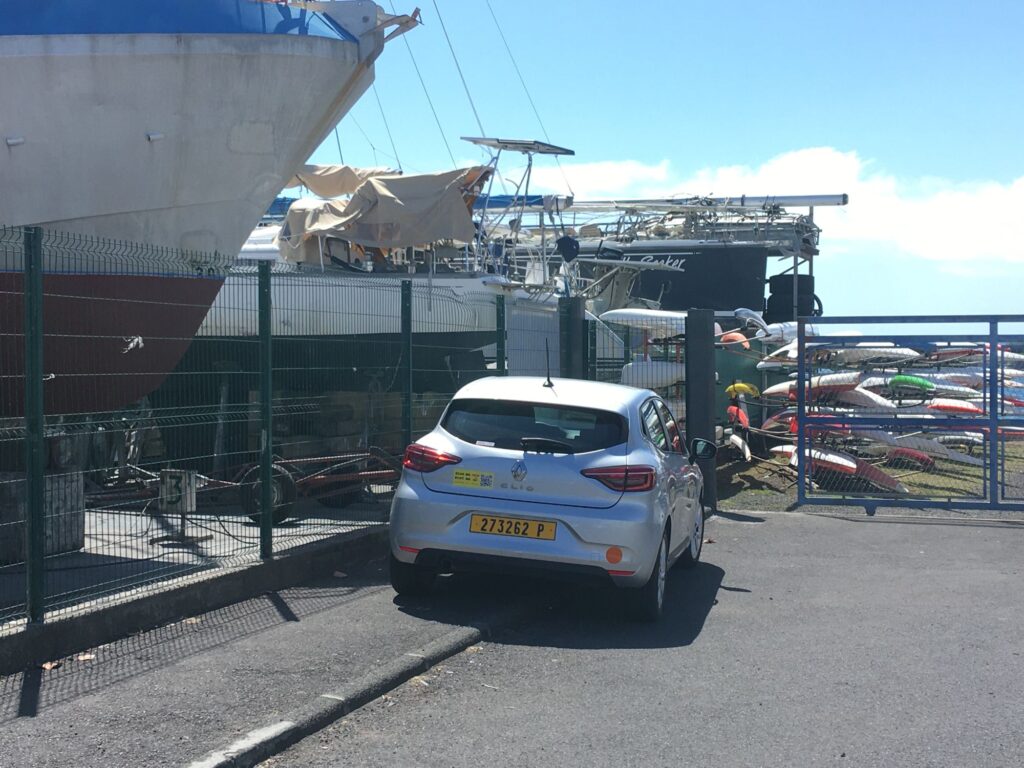
I rented a car for my time in Papeete. There is no Uber type service in Papeete that I found. The car made it easy to run around to the marine chandlerys and pick up a few things I needed. There is even a big Ace Hardware store near the boatyard where I found, of all things, Coleman gas canisters that fit the Magma grill mounted on my port pushpit. I left the US with 3 cannisters and only had 1/2 of one remaining, never seeing them anywhere else I’ve been, until now. I bought several so I can start grilling again. I also did some touring, driving the coast road around the perimeter of Tahiti Nui and stopping at a quaint beach place for lunch. During the drive I had some spectacular views of the steep, forested interior on the island.
With the sail repaired, repairs I hope will last until at least Australia, I had the boat dropped back in the water and drove it inside and outside the reef south passed the airport to Taina Marina where there is a real fuel dock. I filled the main diesel tank and any empty jerry cans so the boat has more than enough fuel for the run to Australia. In fact, I don’t expect to use much fuel with easterly winds continuing to prevail along my planned route.
So what about my route now? I had to bypass Rangiroa and head straight to Papeete for sail repairs. The next stop would have been Huahine. But with the time burned going to Papeete and days I spent there, any visit to Huahine would have to be a really short one. Making the effort to drop the dinghy in the water, mount the engine, and then reverse the process, for just a day or two ashore doesn’t seem worth it so I dropped the stop in Huahine.
After Huahine I planned on stopping at Suvasuva in Fiji (Vanua Levu Island) where they’ve just completed a great new marina with restaurant , fuel dock, etc. (Nawi Island marina). After the extended stay in Papeete, and taking on full fuel at Taina, taking s break in a marina became less important. It also is a bit out of the way on my direct course to the Torres Strait and ultimately Darwin where I want to leave the boat during the tropical storm season from November to April. Darwin is also most efficiently positioned to sail to an Asia port somewhere for my 6th continent landing, then continue across the Indian Ocean and around the tip of Africa.
So the current plan is to sail to Vava’u in Tonga for a short stop because I’ve never been there (unlike Fiji). It will also give me a chance to reassess crossing the Coral Sea to the Torres Strait at the northern tip of Australia. Vava’u is also a pretty well-protected place where people wait out tropical storm season.
The usual route for transiting the Torres Strait begins at a point just south of Bramble Cay. As might be expected, it is heavily travelled route with lots of big ship traffic and strong currents. It’s far from ideal for a small boat, especially sailing solo where keeping an active watch for ships full time for 40+ hours is not very feasible.
In browsing some cruiser forums about the Torres Strait I read others describing an alternate route, a shortcut that crosses the Great Barrier Reef (GBR) beginning at Raine Island and continues northwest for about 120 nm to Thursday Island where the Torres Strait passage is made. Yes, you’re right if you guessed Thursday Island is between Wednesday Island and Friday Island. The Raine Island passage is described in an obscure book by Ken Hellewell written some 20 years ago. I thought I had no chance of locating a copy so was surprised when I found a kindle version on Amazon. It has specific GPS coordinates and mini-chart extracts for the entire route which necessarily maneuvers through the myriad of coral reefs in the GBR. It even identifies a few anchorages he successfully used when he made the passage, although one is now off limits as a Protected Area in the GBR Marine Reserve. With no ship traffic nor strong currents, and shorter, it seems like the better route to get through to Torres Strait.
So, following Vava’u my destination will be Raine Island about 2500 nm away. That’s now the plan. If the weather reasonably cooperate, and nothing significant on the boat breaks, it should work out. However, if things go slowly I may skip Vava’u and continue straight on to Raine Island.
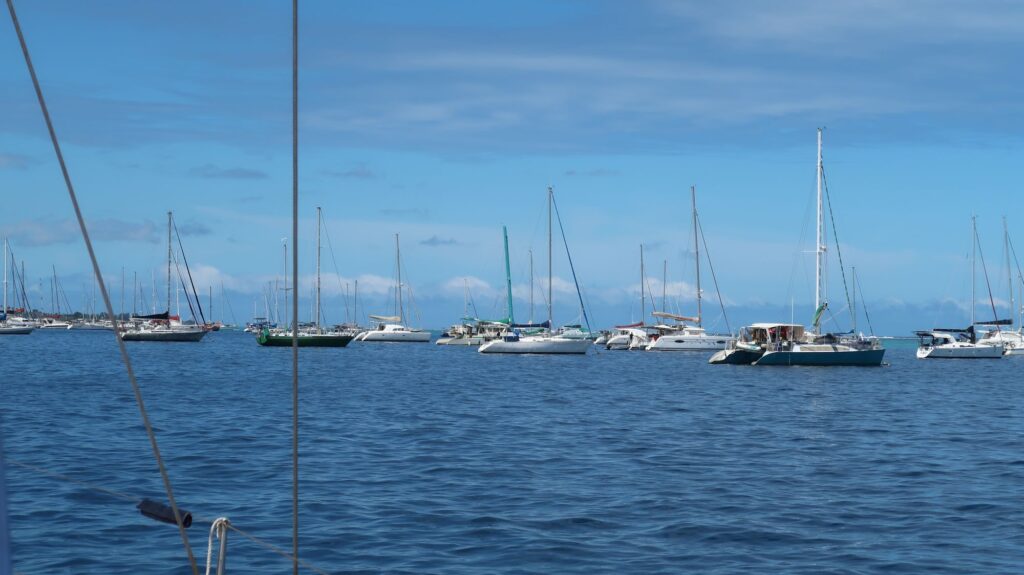
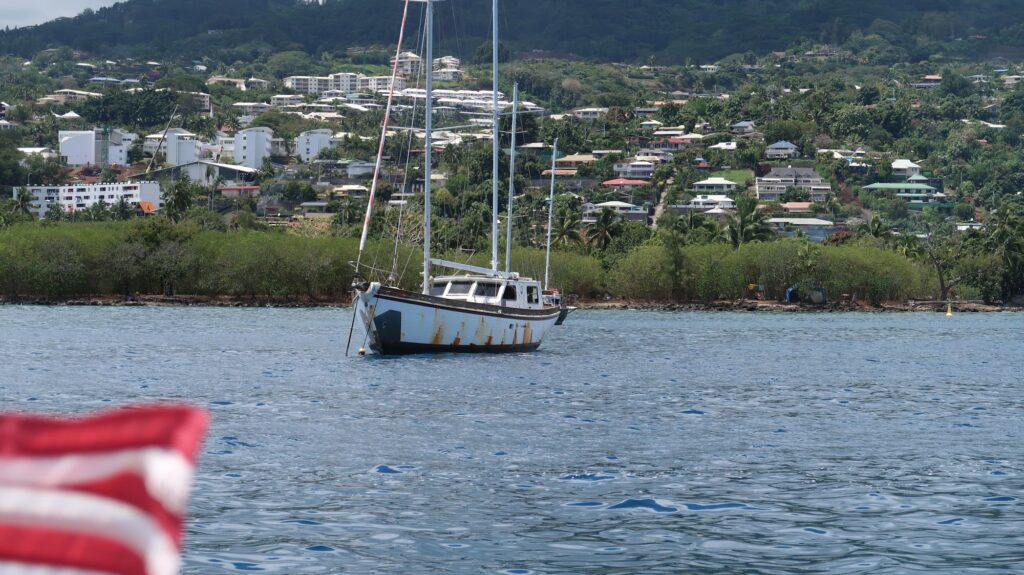
Phywave being hauled out.Hilton Tahiti hotelSunset over Moorea from the HiltonYou’ll have a tough time finding a place for your car if you’re not willing to park on the sidewalk.Rack of lamb at Restaurant Le Grillardin in PapeeteMany boats anchored inside the reef at the airport and Taina marina anchoragesOne of many probably derelict boats in Papeete
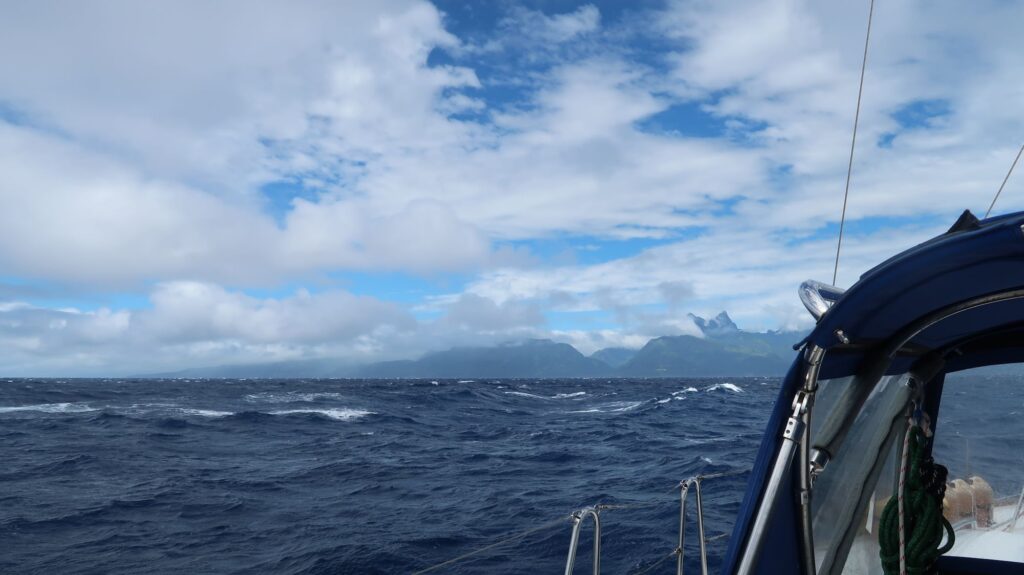
As I mentioned in a recent post, I had no desire to visit Papeete where I had been before, more than once, but sailing circumstances forced me to change my mind. The day after I left Nuku-Hiva I had a serious problem show up with my mainsail such that I could only raise it halfway.
My mainsail uses what’s called a ”bolt rope”, a rope sewed into the luff (leading edge) of the sail. The rope fits in narrow track that is attached to the mast with hinges so the track can rotate. It’s critical the bolt rope easily slide up and down the track as the sail is raised and lowered (reefed). Over time the sail cloth that wraps around the bolt rope has gotten worn, in some places split open. The first repair on this was done in the Canary Islands where the sailmaker used Kevlar film to patch over worn places along the bolt rope. That worked pretty well since the Kevlar doesn’t add much additional diameter to the bolt rope. Increasing the diameter of whatever is wrapped around the bolt rope, of course, would make it more difficult for it to slide in the narrow track.
The sailmaker in Puerto Montt also attempted to patch the bolt rope but didn’t have Kevlar film so he used conventional Dacron sail cloth, much thicker than the Kevlar film. This seemed to slide OK when we first nearput the sail back on in Puerto Montt, but the hoisting and reefing action on the sail during the passage to the Marquesas eventually caused the Dacron cloth to bunch up around the bolt rope making it difficult to move the sail up and down the track. I saw what was happening and tried to trim back the bunched-up Dacron but that really didn’t work. Finally the jam got so severe the bolt rope jumped out of the track and causing further damage to the bolt rope cloth covering, like shredding it. This happened at a third batten down from the top so I could only raise the main sail that far. It would have been crazy to try to continue my voyage as originally planned with such a major problem with the mainsail.
I decided I needed to pull the sail off, get rid of all the bolt rope patches, and have the bolt rope entirely re-sewn to the sail. The sail itself is in very good shape. The only sailmaker who I considered competent and equipped to do this work is in Papeete – Tahiti Sails. With that reality, I changed my routing and headed straight for Papeete where I am now. I don’t know how long this repair will take and to what extent it will affect my plans to get to Australia by November. I do know that people leave boats needing serious repairs to their hulls, etc. in Papeete for extended periods. Worst case is if Tahiti Sails can’t make the bolt rope replacement and I have to box up the sail and ship it back to the manufacturer in the US for repair. I’ll hand the sail over to Tahiti Sails on Tuesday and hopefully have their assessment soon thereafter.
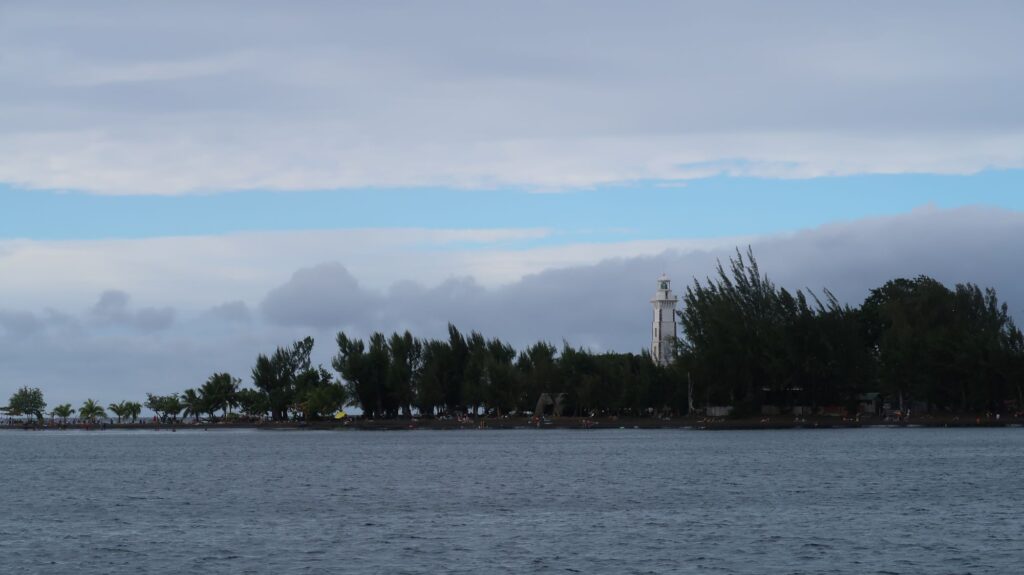
Right now I’m anchored in a place call Pointe Venus, a calm anchorage,i just a few miles north of Papeete but with only one other boat here. This is unlike inside the reef around Papeete itself where there are hundreds of boats anchored or on mooring buoys, some derelict, and two large marinas which are perpetually full. The glut of boats in Papeete is another reason I didn’t want to come here. Since there’s no space in a marina for me, it’s likely I’ll have the boat hauled and put on the hard so we take down the sail so the repair can be done. I don’t want to anchor out with the other boats and try to remove the sail and manage the repair process by commuting in my dinghy.
Oh well, the good and bad come with the mission I set for myself. I’ve booked an ocean-view room at a nice hotel and a rental car so at least I intend to make the best of the time while i’m stuck in Papeete.
Rough seas on the beam approaching Tahiti (Papeete)Anchored in calm conditions behind Pointe Venus
After a 45 day, 5,500 nm passage from Puerto Montt, Chile, to the Marquesas I was looking forward to a well-earned break from sailing. My week in Baie de Taiohae was certainly a break from sailing but unfortunately not the relaxing, restorative interlude I hoped it would be.
The bay is reasonably well-protected on 3 sides but is subject to a fairly continuous swell from the south that will roll the boat back and forth depending on how large the swell is. Even the catamarans I saw at anchor, which are generally much less susceptible, were rolling around a little as well. It wasn’t seriously uncomfortable, mostly just annoying.
To get to shore I needed to use the dinghy, of course. To pick the dinghy up off the foredeck, pull it back to the stern, mount the 6 hp Yamaha outboard (60+ pounds) in the dinghy, add the gas tank and oars, all takes more than an hour. Getting the outboard out of the storage locker on the stern of Phywave and getting it on the dinghy transom is a pure muscle job. When I finally leave the anchorage I have to reverse that whole process.
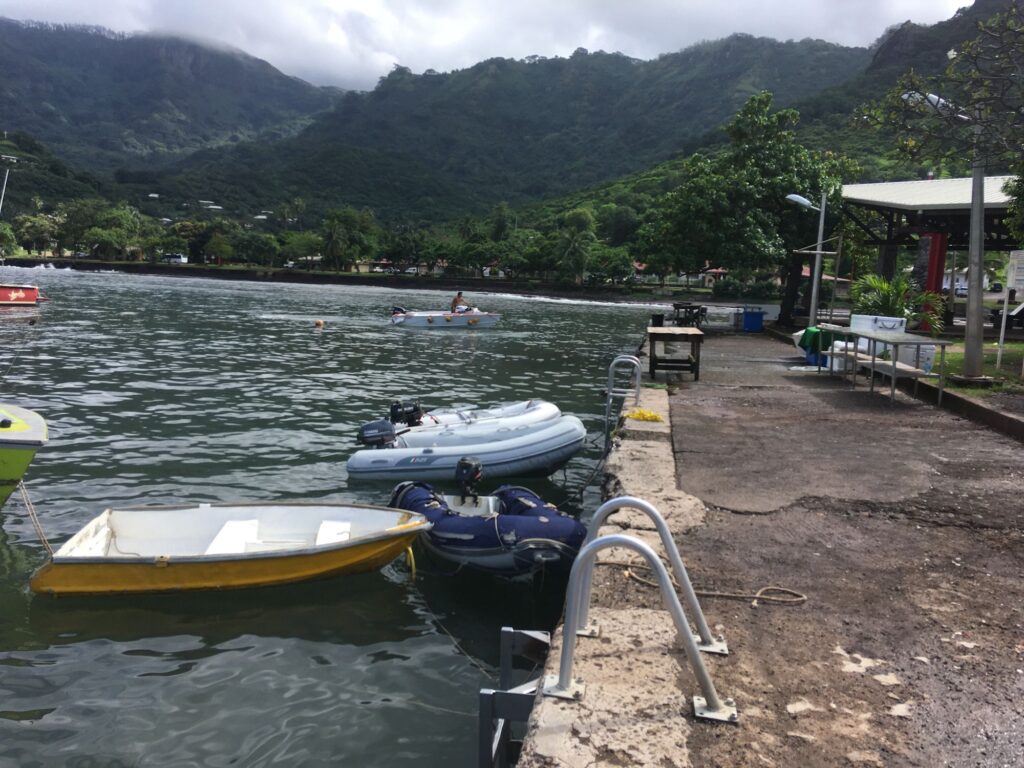
The swells, and wind waves that sometimes pop up, can make for a bumpy ride in the dinghy from Phywave to the place on shore where we can tie up the dinghies. I won’t call it a dinghy dock because it’s just a concrete wall with a couple of ladders and chain along the top where dinghies can be tied. There isn’t a lot of space especially since local fishermen tie their boats to the same wall with some using stern ties to buoys. It’s easy to get tangle with the stern ties coming in as I did once.
With not much space the normal process with 2 people would be to nose the dinghy to the wall and have the forward person grab the ladder or chain and tie the dingy to it. However, with one person, I’m necessarily sitting in the back running the motor so I have to swing the dinghy sideways to grab the ladder or chain, a challenge with a crowded space.
I’m explaining these details to point out that taking the dinghy to shore was a hassle. Of the 7 days I anchored in the bay, I only took the dinghy in 4 days. While I was there the bay only had about 2 dozen boats at anchored, and only about a third of those had people on board. The others were anchored long-term (it’s free) while the crew went off somewhere else, even a back home for a break. I’ve seen photos of the bay with more than 50 boats, most will crews on board. That would have made for a vastly more crowded dinghy landing than I experienced.
There is a gray sand beach near the dinghy landing which people occasionally use to land their dinghies. I tried that one day instead of the wall. It was more work and sand got everywhere. Even with small swells breaking on the beach it was still some work to push the dinghy out past them to get going back to Phywave. Later someone told me there are sometimes small hammerhead sharks in those waters. Great! But apparently they only come around early in the morning for a wild chum feeding frenzy when the local fishermen are cleaning and cutting up their catch and throwing the scraps in the water.
Taiohae is the administrative capital of the Marquesas but even so, there isn’t a lot there. Beyond the government buildings there is one really good hotel with 20 bungalows (and no vacancies) a handful on guesthouse/pensione type places, 4 or 5 restaurants, 3 or 4 small grocery stores, and variety of tourist shops and tour companies. The grocery stores were adequate to re-provision the boat. In Puerto Montt I had bought food for several months so I really just needed to replace what I had consumed en-route to the Marquesas.
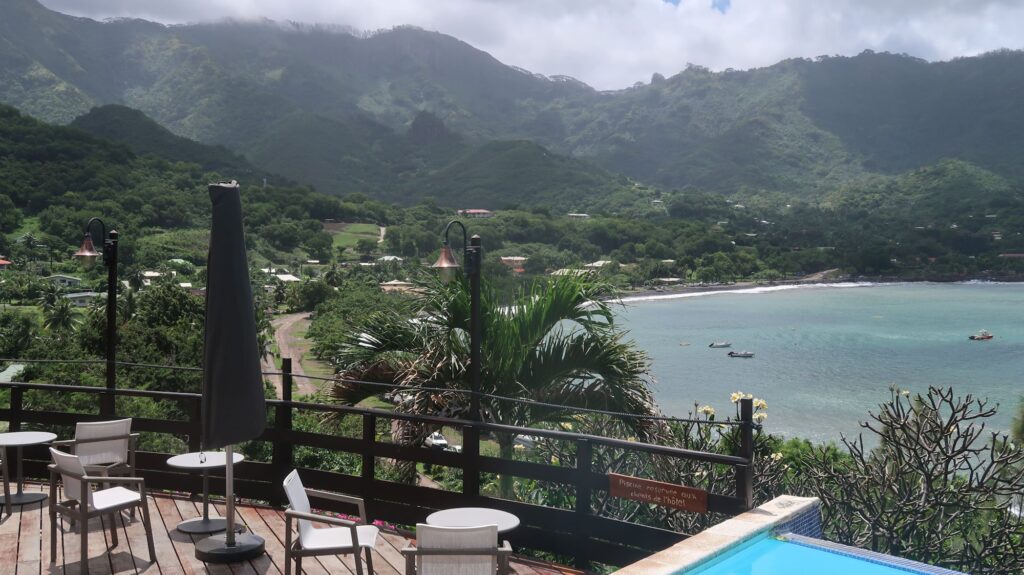
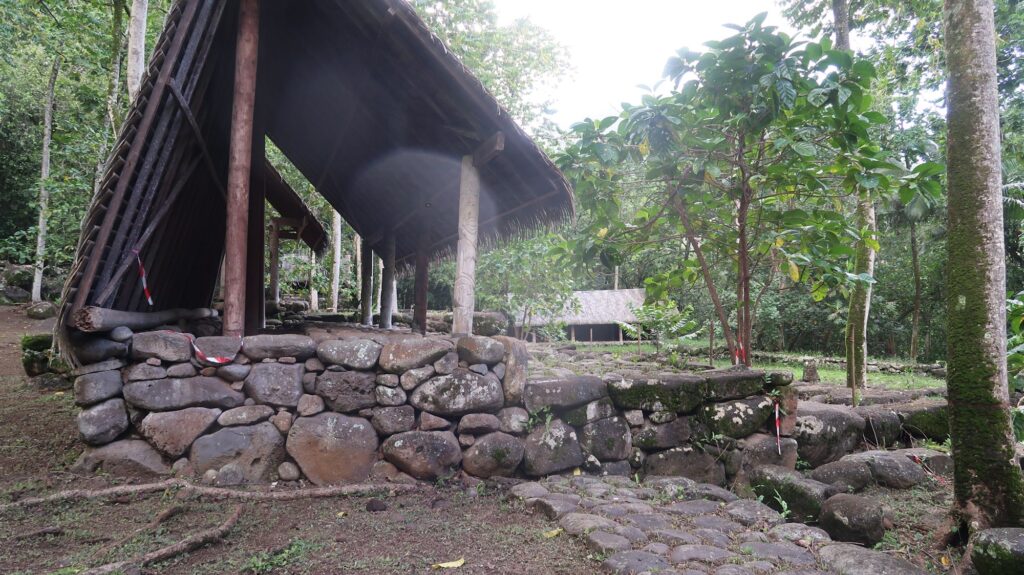
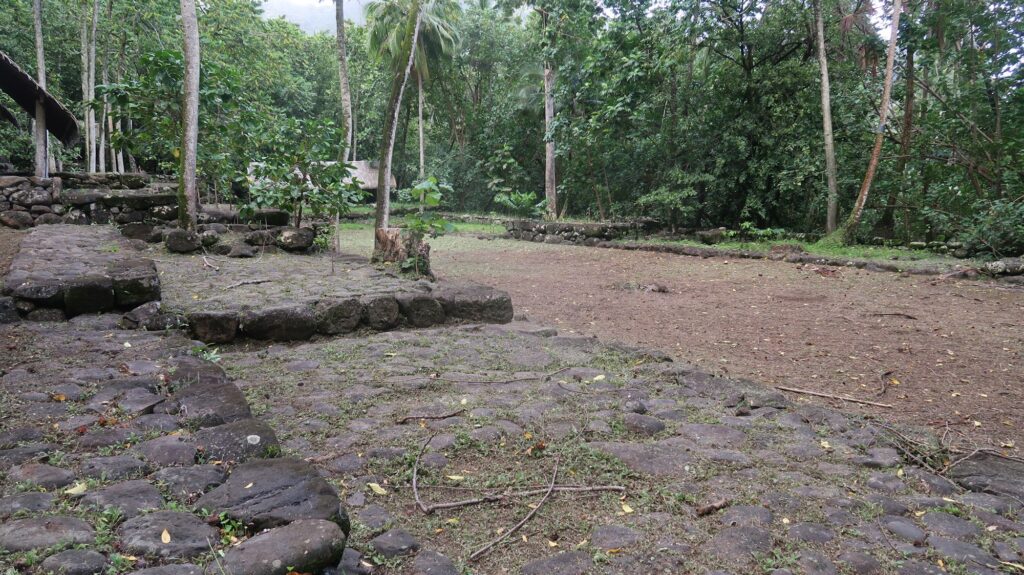
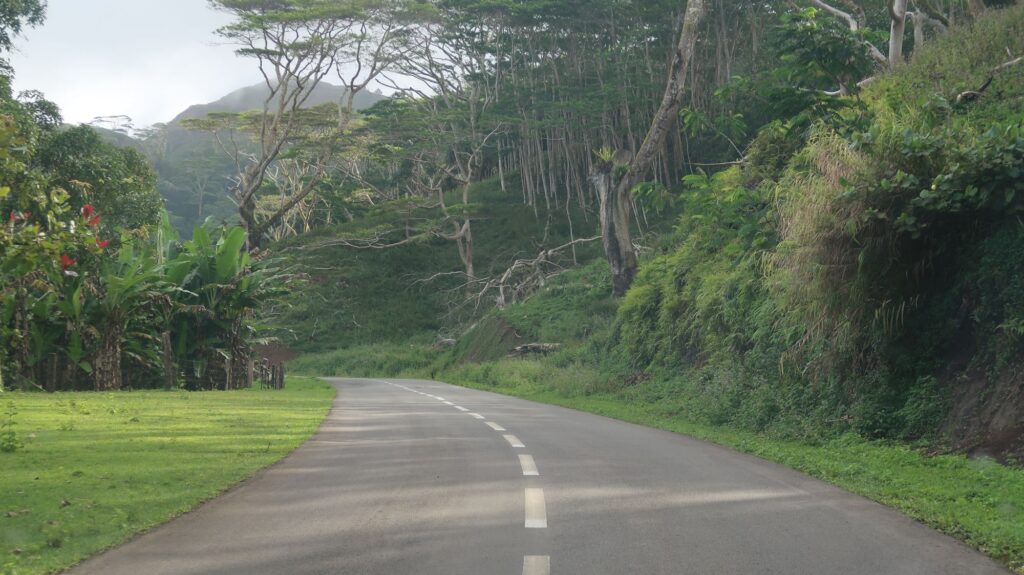
The best day I had on Nuku-Hiva was Friday when I rented a car, had lunch at the upscale hotel with its amazing view, and drove around a good portion of the island to see 500 year old archeological ruins and small villages nestled at the heads of the many bays around the perimeter of the island. Driving on narrow paved roads up and over steep forested ridges provided some spectacular views.
On my first day ashore I did meet a couple from Austin at lunch that were sailing a nice 44 foot catamaran. They had arrived in the Marquesas from Panama, as I recall, and spent 2 months anchored in the Taiohae Bay. Of course, they knew every place in the town and shared than information with me, but I didn’t see nearly enough in the town, or on the island, to justify staying there that long, especially in an anchorage that was sometimes kinda rolly. Some folks just love to hang out on their boats, and have made a lifestyle of it. I guess I’m not among them, instead pursuing my sailing mission.
When the end of my week came I didn’t hesitate to up anchor and move on.
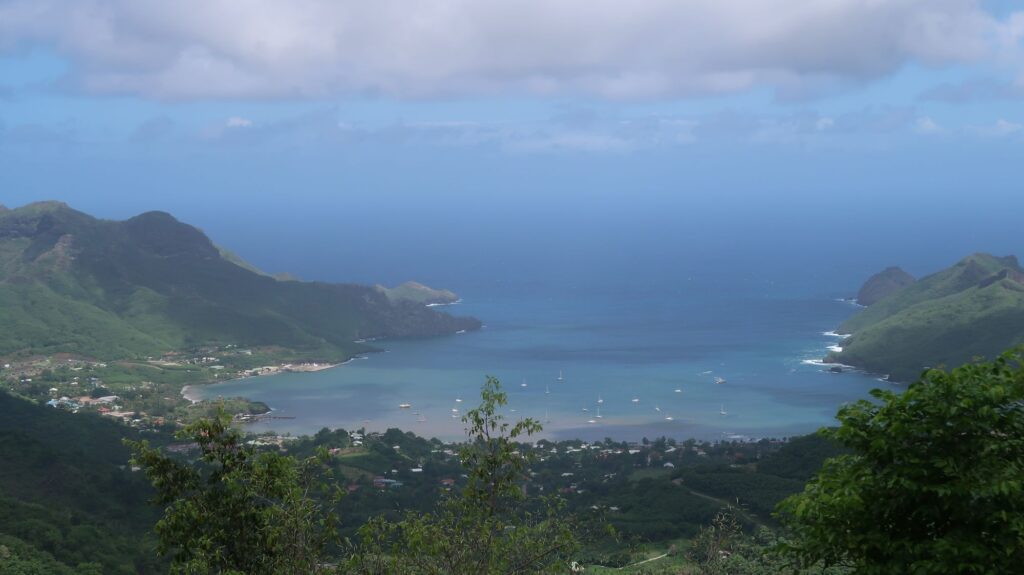
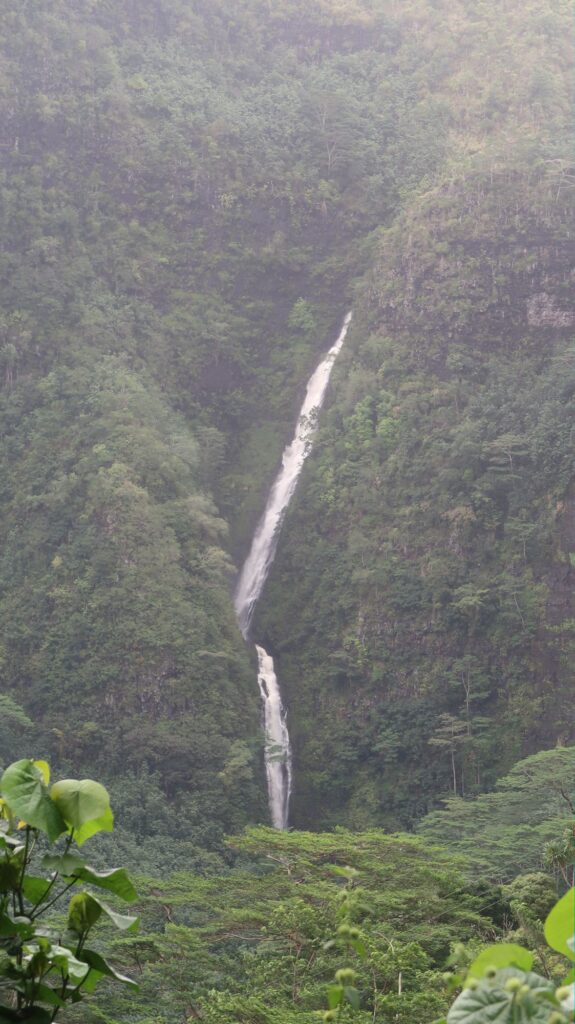
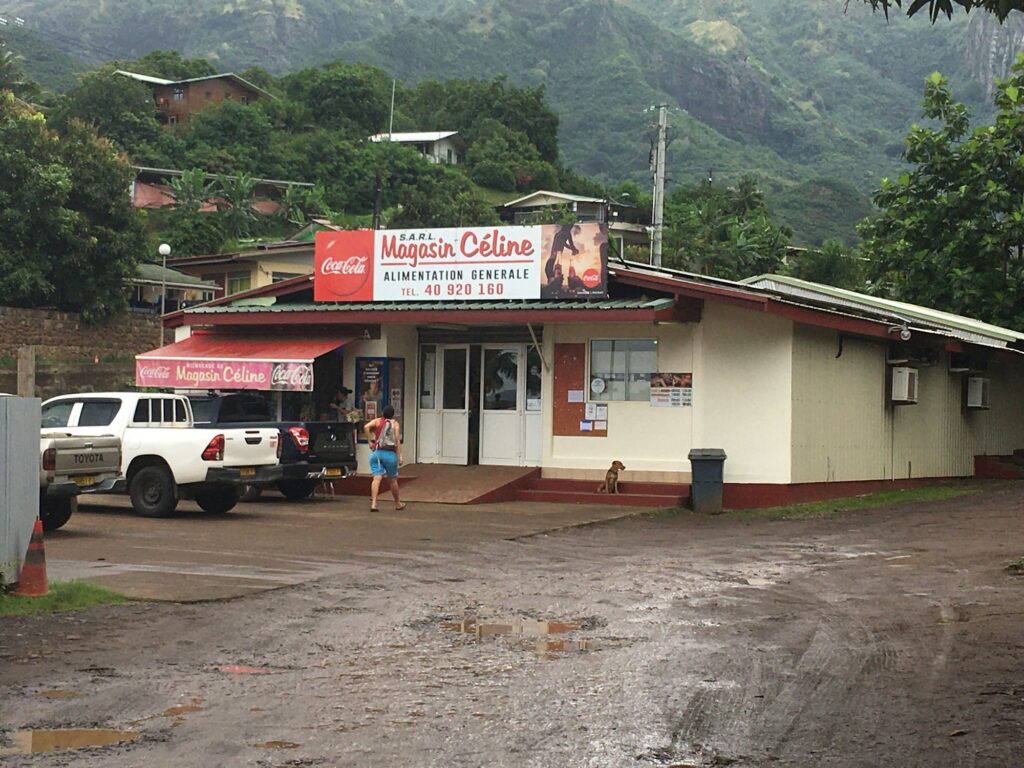
Le Nuku Hiva Pearl Resort where I had lunch.Phywave at anchor in Taiohae BayTaiohae BayArcheological site of a village built by Marquesians 500 years ago.Archeological site of a village built by Marquesians 500 years ago.There are many waterfalls in Nuku-Hiva, one about 1,000 high but unfortunately not accessible by roadPretty well-maintained roads around the islandThe dinghy landing wall.Celines – my favorite little grocery store in Taiohae
Yesterday afternoon, August 20, I anchored in Baie de Taiohae on the island of Nuku-Hiva in the Marquesas island group in French Polynesia after a 5500 nm, 45 day passage from Puerto Montt, Chile. It’s by far the longest passage I’ve done, or will need to do, to complete my solo voyage to 7 continents and my solo circumnavigation.
This morning, using my spinnaker halyard to lift my dinghy off the foredeck where it is strapped down during passage, and muscling my 6 hp Yamaha outboard motor onto its transom, I connected the gas tank, primed it and and crossed my fingers it would start. Luckily it did with no drama – not always a sure thing after it’s been bumped around all those days at sea.
Taking the dinghy into town, my first task was to complete clearing-in paperwork with the Gendarmarie. That done, I’m now good to stay in French Polynesia up to 90 days. Some cruisers get long-stay visas and stay here for months, even years. Kevin Ellis at Yacht Services Nuku-Hiva made this clearing-in process very streamlined. After exploring a few local shops and getting cash at the ATM, I also had my first restaurant meal and beer in a long time!
I plan to stay here about a week to add to my provisions, top off diesel supplies, and fill the propane tank I’ve been using (the second one is still full). When I’m in a place with resources it makes sense to fill up everything – I’ll need it eventually. I ran my watermaker for a couple of hours while motoring in here so I’m set for fresh water. I can also get laundry done and dump accumulated garbage from my passage. With chores done, I hopefully will have some days to relax, look around, maybe rent a car for a day to tour the island. And check out more of the restaurants here!
Unfortunately, I lost 6 weeks from my original schedule for various reasons, 6 weeks I would certainly like to have back now so that I could take a more leisurely island-hopping route on to Australia, which will be my 5th continent. As it is, I need to keep moving. From here I plan to sail southwest to Rangiroa in the Tuomotus island group and anchor inside the atoll for a couple of days. Then it’s on to Huahine, my last stop in French Polynesia. Having been to Tahiti (Papeete) and Moorea several times over the years, I have no desire to go back. They are crowded with cruising boats and tourists engaged in all sorts of loud, annoying water activities. The locals have also imposed increasingly tight restrictions on where cruising boats can anchor at these islands as well as Raiatea and Bora Bora, a long-simmering conflict that has seen cruising boats and dinghies sometimes damaged from vengeful locals.
From Huahine I’ll sail directly to Suvasuva, Fiji. I really wanted to stop in Tonga (Vava’u), a country I’ve never visited, and it’s on the way to Fiji, but I really don’t have time. I plan to have the boat in a secure location in Australia for the tropical storm season which traditionally begins in November. “Traditionally” is becoming a broken word when it comes weather. Climate change is eroding weather patterns that sailors have relied on for centuries.
As I explore this beautiful volcanic island of Nuku-Hiva I’ll be posting more photos.
Early this morning I sailed west of 122.5 degrees west longitude which is not important except it’s the approximate longitude of my house on Bainbridge Island. At this point I’ll recognize any scrap of progress, no matter how insignificant.
There have been many movies with a scene of an 18th century sailing ship becalmed in an ocean somewhere, drifting around a dead flat sea, its canvas sails hanging limply from the yardarms in forlorn anticipation of new wind. The crew sits around on deck in whatever hint of shade they can find, or construct with spare sails, as an intense merciless sun beats down on them. Though there’s no breeze to be found on deck it’s better than being in the stifling, rank atmosphere below deck. Some kill time whittling or scratching scrimshaw while others sit with their backs against a bulkhead, sweat dripping down their faces, eyes closed, as they try to fill their thoughts with images of home. Some occasionally dip a ladle into a wooden bucket of seawater and pour it over their heads, the brief cooling lasting only a minute.
One seaman happens to notice a bird fly by, barely flapping its wings to gain loft. He looks to the top of the mainmast where a pennant is gently stirring. No, it can’t be, it’s just another tease from Zephyrus. But as he watches the pennant begins to lift and slowly wave. Others notice him and also look skyward, each with a flicker of hope their windless oblivion is ending. Then the topmost skysail sail fills with a resounding “whap”. Now everyone is looking up as the sails begin to fill with wind from the top down. The crew is on their feet, a cheer rises as the ship slowly begins to move through the water. The officer on deck steps up to the helmsman who simply nods that he has steerage. The officer gives an order to turn the ship to take best advantage of the rising wind. The crew gladly scrambles up the masts to adjust sails. Their long drifting nightmare in the doldrums has come to end.
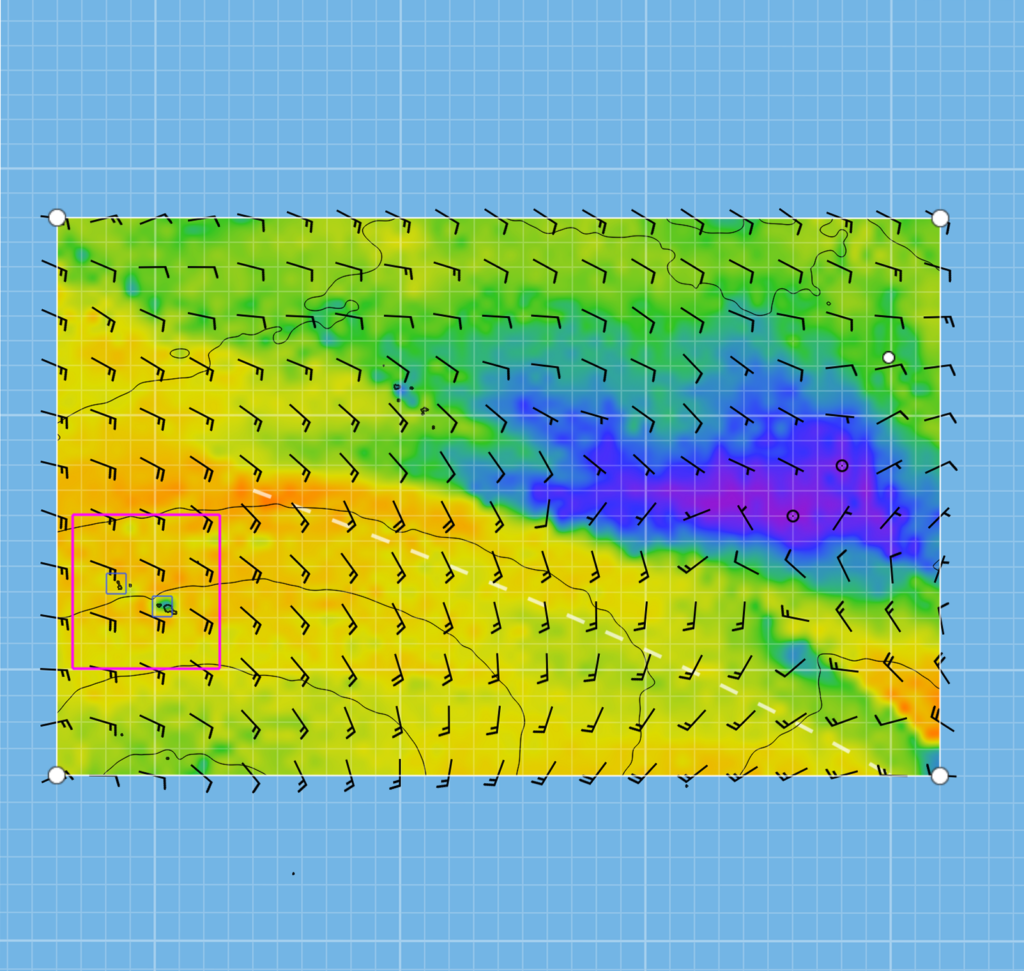
That was me for a couple of days as the wind speed fell below 5 knots and its direction wander over a 50 degree range. The SE trade winds at this latitude, even much further south, should have been fairly steady in direction and speed. But this is an El Nino summer, renowned for lighter, variable trade winds. I have first-hand evidence of that. I’ve had to work my way progressively further north than I ever expected to get around a large patch of dead air hundreds of miles across encroaching from the south. Of course, unlike the 18th century ships I have “iron wind“, an engine I can use to keep making progress. But the engine is loud, and its heat adds to the already 32+C degree temperatures outside. It’s even hotter in the cabin.
As I write this some wind has returned, at least enough to work with to get this boat moving again under sail.
I’m about 1000 nm from Nuku-Hiva, expecting to arrive there on August 20 or 21, depending , as always, on the winds.
Weather forecast with the white dot near the right edge showing my boat location. I’m trying to work my way around the north side of the blue area where there is little or no wind.
Virginia, where I topped up the fuel tank and spent the night, I set off eastward the following morning, August 2, 2022, headed for the Azores.
I’d sailed for many years but in relatively protected waters removed from the ocean, like around Puget Sound and in te channels, island passages and harbors north of there. This was my first excursion offshore, my first time being underway alone at night, but fortified by naïveté and blind faith, I sailed on into the night, asleep in my bunk with the autopilot in command. It’s only water out there, a vast ocean, nothing to run into. The first night was peaceful, the second I was awaken by a brief, intense rain squall that had me scrambling up on deck with my headlamp on to reduce sails. By the time that was done the squall had moved on and I put the sails up again.
Since those first days I’ve learned a lot about sailing, especially ocean sailing. I’ve had so many adventures that the past year seems compressed, like how could all those things have happened?
Aside from the 3 month break I took at home this Spring, I’ve spend the other 9 months alone on Phywave.I’ve landed on 4 continents (Europe, Africa, South America, and Antarctica) and in 6 countries (Portugal, Morocco, Spain, Brazil, Argentina and Chile). As I write this the boat’s trip log says I sailed a total of almost 17,000 nm. On the current passage I’ve sailed about 3,200 nm thus far from Puerto Montt with 2,200 nm remaining to arrive at Nuku-Hiva in the Marquesas Archipelago.
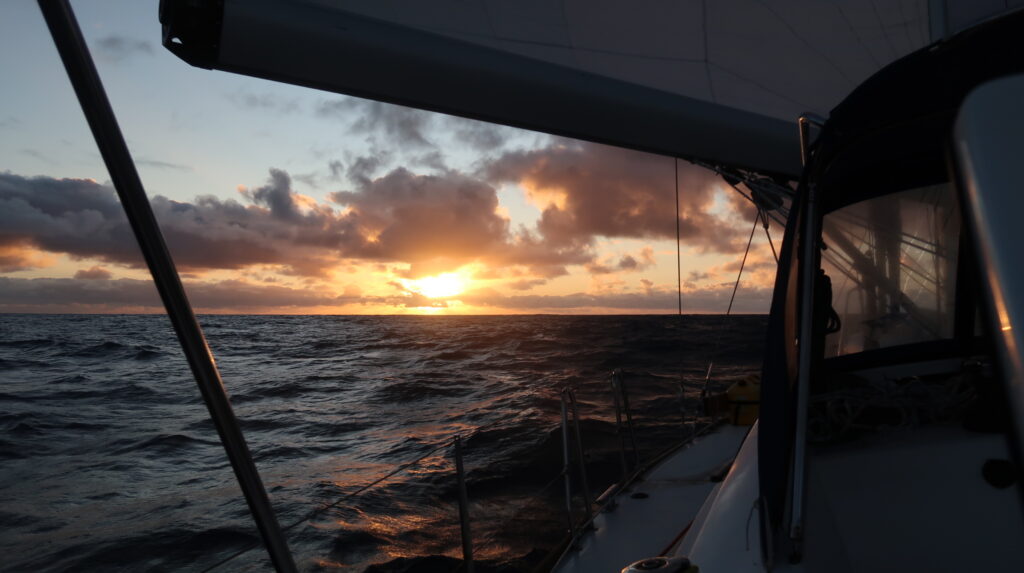
I’m sailing west across the Pacific into a setting sun,a common sailor fantasy now real, though I still see the clouds above me as a pilot would, not a sailor. With thousands of hours flying solo in my small plane all over the world, I don’t think that will ever change. I wouldn’t want it to change.
The days now on this passage are similar, flowing together with no distinguishing features, the trade wind direction and speed finally fairly steady, a sky that suddenly clouds over then just as quickly brightens to brillant blue, seemingly at random, followed by recent nights lit up with a moon waxing full. It’s the upper half of a world that has the hypnotic, twisting rythmn of the waves beneath. And me in between.
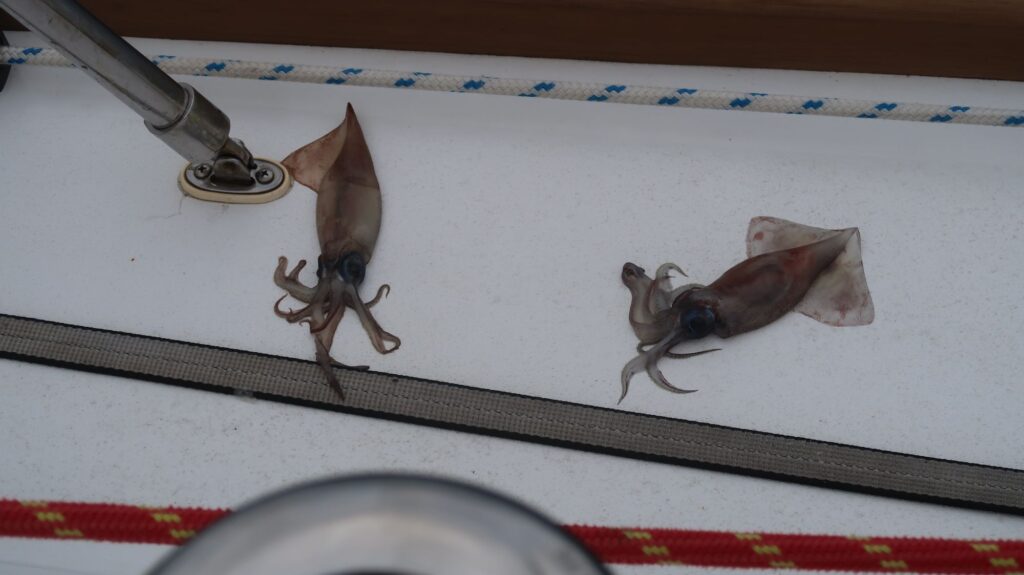
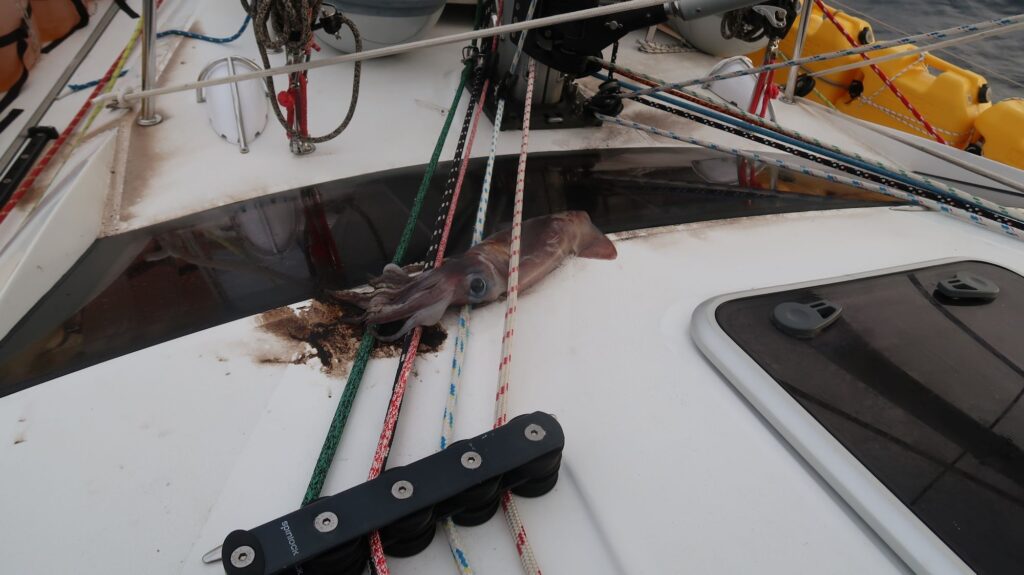
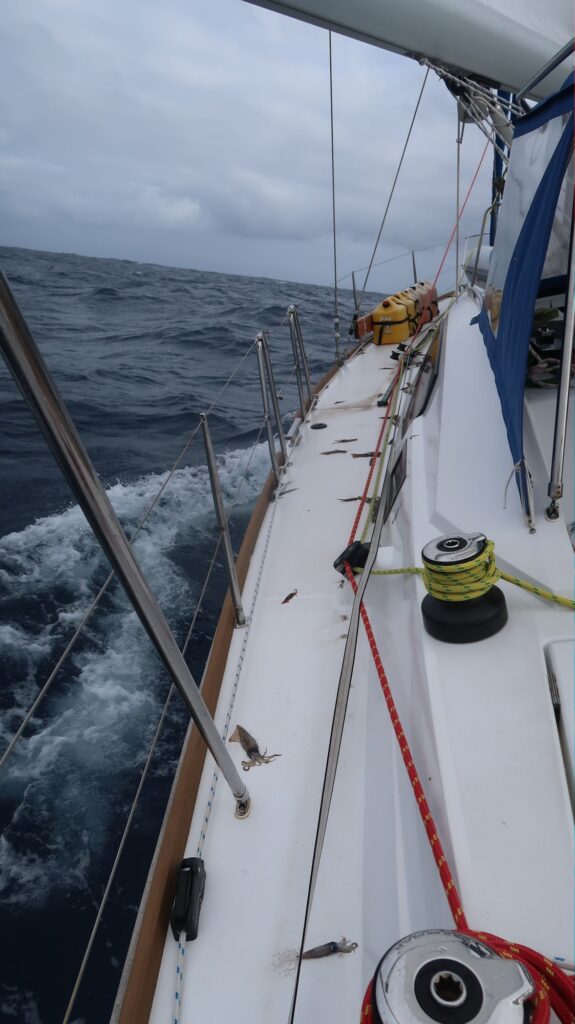
Crossing the Atlantic it was common to find dead flying fish on the deck, even in the cockpit. I’d see these fish spend a fair amount of time airborne skimming across the water so it was not a great surprise to see some of them end up on the deck. But I don’t know what’s up with all these squid that started showing up on the deck in the Pacific. They can’t fly so I assume they get tossed on deck by the waves that routinely hit the hull of Phywave and break over the deck. Most are less than 6 or 8 inches long so don’t weigh very much and water could easily toss them around. However, a few days ago a really big one landed on deck, about 18” long with tentacles, weighing over a pound. Somehow it got wedged under the headsail halyards. I tossed it overboard but now I’m hoping for a short, intense rain squall to wash the bloody mess off my deck. And as of a few days ago the dead flying fish are also back.
I’ll pass 90 degrees west longitude today, due south of the Galapagos Islands 840 miles to the north, a very interesting place I visited for a week back in 2007. From my current position there remains about 2950 nm to Nuku-Hiva in the Marquesas Islands (about 24 days averaging 5 knots). My boat trip log says I’ve already sailed 2350 nm from Puerto Montt so this will be a 5300 nm passage when I arrive there, more than twice as long as the longest passage I made in the Atlantic.
I’ve just added a new page entitled “Sailing Videos” under the Sailing section of my website www.phywave.com. These are short, unedited video clips posted on my YouTube channel that better convey the sailing experience than still photos can.
Squid on deckBig squid stuck under headsail halyards.Squid on deck